Picture
A few years back, after I spent an evening at a
halfway house for men on parole, Sister Mary Sean Hodges challenged me. She has worked tirelessly through the Office of Restorative Justice, LA Archdiocese, on behalf of incarcerated men and women and those seeking to reenter society. She liked what I'd done advocating for gang members, prisoners, and criminal justice reform, but in her view I had fallen short. "You have to meet the victims, too," she said.


I did, and soon felt overwhelmed and helpless in the face of so much pain and rage. I wished there could be another way--a better way--to cope with such grief, but when I heard of other ways, I was cynical. I loved Reginald Denny for forgiving the teens who beat him unconscious during LA's civil unrest, but, hey, with his head injury, he remembered nothing of the attack and I figured that made it easier to forgive. As for other cases I heard  about, seriously, would you open your heart to your child's murderer? I wanted to admire such compassion but it seemed more like delusional naïveté. You'd have to be a saint--or crazy. 
 
So it was with a sense of relief, hope, and gratitude that I watched a sneak preview of Leslie Neale's new documentary, Unlikely Friends, about victims who reached out to the perpetrators whose brutal crimes had caused so much hurt and pain. Perhaps the most remarkable thing about the remarkable relationships she documents is that they actually make sense.

You can see the trailer here:   http://www.unlikelyfriendsforgive.com/trailer


 The seed for the film was planted about 20 years ago by a bank robber named Nelson who was featured in Neale's first documentary, Road to Return, about an innovative post-release program for the formerly incarcerated. After serving his time, Nelson had returned to the crime scene out of an urgent need to apologize. What struck Neale was not only Nelson's sense of guilt, but the impact his act had on the teller who'd had his gun held to her head. For twelve years, she said
  she'd lived with the fear he would come back and kill her. Meeting him, sharing stories and family photos, and hearing his apology freed her at last from the terror that had refused to let go. There was a bigger story here, and Neale knew immediately she wanted to tell it from the victims' perspective. 

As she recently explained, "Just as reformers say that prisoners need to be involved in prison reform, I think victims need to have more of their voice heard as well." Usually when that voice is heard, it's from survivors such as Harriet Salarno who appears in the film and founded Crime Victims United, a nationwide organization that has been in the forefront of putting victims rights on the public policy agenda. Her work lobbying for tough-on-crime legislation, supporting victims and their families as they attend parole board hearings to present their objections to release, is both easier to understand and strongly validated by the adversarial system. "Victims who choose to forgive aren't really given the time of day," Neale says. People are enraged by them. People call them crazy. Some keep quiet about the choice they've made, but some are willing to speak and Leslie Neale wanted their stories told.

She began to learn about the movement for restorative justice which is based on the understanding that when a person
commits a crime, it's not just a law that's been violated; someone--or a whole community--has been harmed. Punishment alone--though necessary and often satisfying--will not repair damage or help victims move forward with their lives. Restorative justice brings offenders and victims together to provide a chance for perpetrators to make amends and to promote social and individual healing. 

In recent years, some California schools have successfully used the restorative justice model to address school discipline issues. Some police departments have worked with community-based facilitators to address offenses such as vandalism and shoplifting. But could restorative justice really be appropriate for murderers? After watching Unlikely
Friends
, I began to think that victims of violent crime and their perpetrators are the people who need it most.


To cite just one of the unlikely friendships in the film, there's Steve Watt.

 Self-described as pro-gun, pro-Republican, he was a Wyoming state trooper who believed "if you're not a cop or a family member of a cop, you're a dirtbag." Not exactly a bleeding heart. Then a bank robber named Mark put five bullets in him, taking out one of his eyes and leaving him in constant pain, unable to get around without crutches. "I wanted Mark dead," he recalls. Today he calls Mark one of his best friends.

Please watch the documentary before you jump to the wrong conclusion that Steve Watt must be soft in the heart or the
head.


Steve and other crime victims in Unlikely Friends didn't met the offenders in order to love them. They went seeking relief and answers, sometimes confrontationally as when Debbie in Arizona insisted that her son's killer look at photos of the young man whose life he had taken. For Debbie, who had been obsessed with the desire to see her son's killer dead--whether by the death penalty or by her own hands--what she calls "forgiveness" was at first simply saving herself from that all-consuming hatred and bitterness. Today she is grateful that capital punishment was not imposed.

According to Azim Khamisa, whose son Tariq was shot dead by a 14-year-old boy, "Resentment is like drinking poison and waiting for your enemy to die." The author of the book From Murder to Forgiveness, Khamisa reached out to the shooter's grandfather and together they founded the Tariq Khamisa Foundation, dedicated to stopping youth violence. He says, "Forgiveness is a gift I am giving myself."

But if victims reach a place of peace for their own well being through forgiveness, Neale found while doing research and
interviews that offenders were also deeply affected. Profound transformation can occur in the perpetrator when victim and offender meet in dialogue--something usually prevented under our adversarial legal system. Victims usually address
perpetrators only at sentencing hearings when, still reeling with shock and loss, they may call the offender a monster and demand the most severe punishment. Defendants are told not to apologize to their victims and victims' families. If they ignore their lawyers and try to plead guilty and accept responsibility, the judge may refuse to accept a guilty plea. Many prison officials refuse to allow victim-offender dialogue. (And even when they do, many stories don't get told--including those that Neale had to leave out of the film when prison authorities did not allow access.) Upon release, ex-offenders are
often prohibited under penalty of law from contacting their victims--a protection that may be essential in some cases but also prevents victims like the bank teller from finding relief. 
 

Mark admits that when he shot Steve, he didn't see him as a person but merely as an object standing in his way. Now he sees many prisoners who twist everything around so they can blame the victim for their circumstances. He cannot do that. Every time Mark sees Steve or hears from him, he can't avoid facing the awful reality of the impact of his crime. If you never see the pain you've caused, he suspects you'll never learn empathy.  

And that affects everyone. Most incarcerated people are eventually released and if they return to society filled with
resentment instead of insight, we're all in trouble. 
 

In Unlikely Friends, I saw a demanding kind of forgiveness: one that insists first on punishment according to the law
but doesn't stop there. It moves beyond the law to catalyze rigorous self-examination and moral growth on the part of those who've done wrong. If it's love, it starts as tough love. 
 

"Most offenders suffer from guilt," says Khamisa, and as I watched Unlikely Friends, I thought about how easily a person can twist the facts and seek out someone else to blame when the burden of guilt is just too much to bear. 
 

What I witnessed in the film was mutual recognition of shared humanity, a connection that may lead to forgiveness or
friendship but is healing to both parties even if it doesn't. Some offenders may be--at least for now--beyond reach. For many, I think the victim reminds the perpetrator of that all but unbearable guilt but by recognizing the offender's
humanity makes it possible to acknowledge the guilt and carry it. 
 

Ideas planted by Unlikely Friends are still revolving in my mind. It occurs to me that when the perpetrator becomes human to me, I can't hold the same volume of hatred inside me. Besides, I would rather accept that we live in a world in which we all experience pain and sorrow than believe we live in a world populated by monsters.

 *                            
 
A special screening of Unlikely Friends on April 27 in Los Angeles will benefit the Amity Foundation. Among its many programs, Amity provides services to incarcerated men and women as well as men, women and families transitioning from residential treatment or incarceration to the greater community. Amity has used Neale's earlier documentary, Juvies, about teens tried as adults, extensively in their educational programs. (And for those of you who have been following Duc Ta's life as reported at the site, he will go to transitional housing provided by Amity upon his release in August.) For tickets, please click here.  


If you are interesting in hosting a community screening of Unlikely Friends, please request more information here. You can also check the website for updates, to sign up for the newsletter to be informed about additional screenings, or to contact the filmmaker if you wish to order a copy. 
 

To learn more about restorative justice around the world, please click here
 
This article appeared on April 10 in New Clear Vision and April 11 in LA Progressive.


Picture
 
Just a quick note for those who check in here from time to time to find out what’s happening with Duc.

I am so happy to report that his parole hearing ended today with the recommendation that he be released in five months.

It’s about time!

 The decision still has to be agreed to by the whole Board and by Jerry Brown, but we don’t anticipate any glitch there.

 Oh!

And many thanks, as always, to Leslie Neale who has been an enduring support to Duc
ever since she featured his story in her documentary, Juvies.

 Today, she let me know the good news.

And I’ll be reporting soon about her new documentary, Unlikely Friends, about the healing relationships that
have grown between violent perpetrators and their victims.

Tickets for the screening on April 27th in Los Angeles to benefit the Amity Foundation can be purchased by clicking here.
 
 
Picture
Reverend James Lawson and the Power of Nonviolent Action

March 2, 2013

I am more than thrilled that much of the extensive interview I did with
Reverend Lawson back in 2007-08 has finally seen print, in this month’s issue of
The Believer. Here’s the excerpt they put on their web page. I’m waiting for the
hard copy to give to Jim Lawson who may have forgotten by now that he ever
talked to me.

Here's a link to the excerpt The Believer posted at their website.

 
To read the full piece, if you're not a subscriber, the magazine is available from The McSweeney’s Store.


One billion women violated is an atrocity.
One billion women dancing is a revolution.

That was the statement sent out by the One Billion Rising campaign urging women around the world to dance in the streets on February 14 and demand an end to violence against women and girls.

While "Break the Chain," the campaign's music video, screened in the background, three dozen women and a few men in the meeting room of the Los Angeles chapter, National Council of Jewish Women got up and danced before settling down to the serious business of a panel on teen dating violence.

Teen relationships "mimic adult relationships," said Patti Giggans, executive director of Peace Over Violence (formerly the Los Angeles Commission on Assaults Against Women). "If we are really going to stop domestic violence, we have to work with the young."

 "It's more complicated than hitting and physical abuse," said Barrie Levy. We have to look at emotional abuse as a girl's  self-confidence and healthy functioning are undermined by "a pattern of coercive control." 

Levy, a clinical social worker, psychotherapist, and UCLA faculty member, has decades of experience working with families affected by domestic violence and teens affected by abuse in intimate relationships. She offered a typical
scenario:


A boyfriend uses verbal attacks and humiliation to stay in control of his girlfriend. He constantly criticizes her, making her feel bad about herself. He's possessive and jealous, calling or texting her all the time to make sure where she is and
to accuse her of being with other guys. He knows exactly how to hurt her and so she is watchful, afraid to upset him. She apologizes all the time. She is aware that she can't do anything separate from him and so she stops spending time with
her best friend. The emotional abuse begins to escalate to physical. In the beginning, sex was special but he's been rough lately. He uses or threatens to use physical force. He's pushed her against the lockers at school. Now he's hit her a couple of times. And she can't stand the thought of losing him.

Picture
hat's wrong with these kids anyway? Just more  examples of teens and bad decision making? Lindsey Horvath, Regional Coordinator for the One Billion Rising campaign, asked therapist Ava Rose if science has some answers.

 Rose, the director of Women Helping Women, the community counseling and support services at the NCJW, said, "We're hardwired to stay in connection."  As humans--unlike most other animals--we remain vulnerable and in need of care for many years of life. "Relationships are essential to survival," she said, which is why "when somebody becomes attached, that can feel like a life-and-death story." So breaking up isn't just hard to do: it may feel life-threatening. This is particularly true for teenagers.    

Contrary to stereotype, "teens are perfectly capable of making good decisions when their minds are calm," Rose said. But the part of the brain that helps us manage  emotions is still developing at that age. Teens therefore "have a harder time calming their emotions down" and that's when bad judgment comes into play.


But the great part about working with adolescents--the reason Levy loves it--is they are still developing. Which means, she says, "they can change."

Levy reminded the audience what teens may envision as the ideal romance. "It's what you see in the movies. He loves me so much, he wants me all to himself," she said, "but what starts out romantic becomes a prison. You're locked in and can't move."

If we look back honestly at our own lives, "How many of you thought, I want to be in a healthy relationship?" asked Patti
Giggans.


 And what does one look like? Terra Slavin, attorney with the Domestic Violence Legal Advocacy Project at the LA Gay and Lesbian Center, challenged the audience to name a high profile gay couple. Society has changed enough that the media gives us many positive examples of gay and lesbian individuals, she said, but what we don't see are the healthy
relationships.

She also pointed out that lesbian-identified women report abuse by intimate partners at a higher rate than
straight-identified women, and for lesbian teens, it may be particularly hard to leave the relationship. "The fear of being outed to family and school is a threat a same-sex partner can use on the other. LGBT youth are still a
disproportionate number of the homeless youth -- 40%," she said. "So when an abusive partner threatens to out them to their family, it can mean they don't have any place to go."


Giggan's Peace Over Violence organization has now introduced a pilot program in a few LAUSD schools to train teachers to be aware of the signs of teen dating violence and to take appropriate action. If teachers see a boy push a girl up against the lockers and ignore it or just walk by, it's "the worst thing that can happen," she said. It sends the message that people accept this behavior as normal. 
 

Miguel Angel Perez, coordinator of the Male Violence Prevention Project in Santa Monica, acknowledged this as he talked
about transforming "bystanders" to "upstanders," adult men who model a different sort of masculinity for the next generation. "Masculinity is at the root of violence," he said, "so men need to step up and change the culture about
masculinity." 


The project works, for example, with athletic coaches who may use sexist language to motivate their players. If coaches
continue to use misogynistic insults, the assistant coaches and players themselves are encouraged to speak up and challenge this. With fifth-graders, discussions focus on the kids' idea of what makes an ideal man. What does it
mean to be strong? Tough?


Yes, boys need a different concept of manhood and identity. Whether we look at gang violence or the recent examples of Adam Lanza and Christopher Dorner, we see men turning to guns and killing to erase stigma and shame and to reclaim a sense of respect and honor. 

 Slavin added, "We code masculinity in terms of men. We assume that masculine-identified people are the ones
perpetrating violence." This leads to automatic--sometimes incorrect--assumption that the more feminine person in an LGBT relationship is the victim.


Altogether, too many teen relationships--Giggans cited an estimate of 25-30%-- involve coercive control. And if you think it doesn't apply in your home because your kid doesn't date, think again. Many kids today don't even use that language, Giggans and Slavin agreed. They aren't "dating." They are just "hanging out." 
 

How can you know if your own daughter (or son) is affected?

Levy said a tip-off can be behavioral changes. A girl has become more self-conscious, self-critical. She's begun dropping
activities, afraid to do anything that will get her boyfriend upset. She's become isolated, not seeing her friends anymore as the unhealthy relationship demands all her emotional and cognitive attention. 
 

So what do you do? Telling her not to see the boy leaves her caught between a controlling boyfriend and a controlling parent. And if you ask her to choose, the boyfriend will win.

According to Levy, a parent should accept that it's not easy to end a relationship. Focus on keeping your daughter safe. Ask her, Are you emotionally safe? Physically safe? What are you doing to get yourself safe?For example, does she have a way of not being in the car when he's been drinking? Does she know how to get away when he's in a jealous rage? At the same time, focus on building her strength and support. Encourage her participation in other activities and a
life outside the relationship.  


Parents of a boy should be aware if he's temperamental, volatile, quick to blow up. A mother might hear her son being
cruel and critical to the girl. She might realize he's obsessed with his girlfriend because she notices how he pays constant attention to everything the girl is doing. 


Levy acknowledged some of the behavior would be hidden, but "You have to assume it's worse than what you see." A boy may try to blame the girlfriend for his behavior with excuses like, You don't know how she pushes me." Of course a mother wants to believe her son is not at fault. But he needs everyone in his life to point out to him that the way he is treating his girlfriend isn't healthy.

 "The best thing parents have to offer their kids," Levy said, "is a strong relationship. Your kids should know you're there
to support them and help them make good decisions no matter how you feel about the choices they're making."


For parents and other caregivers who want more information and support, Levy and Giggans have co-authored What
Parents Need to Know about Dating Violence
as well as another book forthcoming in Fall 2013. (When they asked around for advice on a title, parents of daughters wanted to call the book I Want to Kill the Bastard while teenagers suggested Parents--You Don't Have a Clue.) This spring, Levy will also facilitate a two-hour workshop, Dating Without Danger, sponsored by Women Helping Women at the NCJW, 543 N. Fairfax, Los Angeles. The date is not yet confirmed but  interested parents should contact Abha Verma at 323-852-8522 by March 4 for further information or to enroll. 


Finally, a confession: As I left the meeting to meet a friend and go join the dance, there were memories I couldn't shake. I
remembered when instead of being an upstander, I was a bystander. Junior high. There was a girl in my class, a lovely girl, an honors student, friendly, liked and respected. Then the gossip started going round that she was seeing the local
"bad boy" and she was "letting him" hit her.  And while we gossiped, we felt ashamed of being girls. Our classmate's situation made us feel uncomfortable, icky. Even disgusted with her. I used to have nightmares in which she'd be running from that boy, trying to escape. She'd come to me for help, crying and showing me her bruises. In real life, I never tried to talk to her. I certainly hope someone did, that she had a friend or parent who did more than just gossip about her.
And then wake at night from bad dreams. 


ACTION ALERT: On February 12, the Senate
reauthorized the Violence Against Women Act, S. 47. But now the VAWA measure
needs a vote in the House where conservatives wish to remove about 14 words (out
of 200 pages) intended to ensure that tribal women, immigrants, LGBT
populations, and communities of color are not discriminated against in funding
or services. Please contact your representative to urge support for the Senate
version of VAWA and protect all women. 


Picture
My article published January 6 in LA Progressive:

Jorge Parra is speaking out--even though his lips are sewn shut. 

Parra was a skilled trades welder when he went to work for General Motors Colombian subsidiary Colmotores. There, he developed herniated discs, severe carpal tunnel in both hands, and upper spinal tendinosis.

In a translated written statement, he explained, "I underwent three surgeries and now walk with a cane due to the injuries I sustained at GM. When I first started feeling pain in my lower back and legs...I went to GM’s medical center. They gave me injections of Oxycotin and Diclofenac and sent me back to work."

Parra, who now has several screws implanted in his spine, responded by organizing ASOTRECOL [Association of Injured Workers and Ex-Workers of General Motors Colmotores] in May 2011 and was promptly fired for "instigating resentment."

Today, he is in Detroit, his travel paid by a US-based NGO, coming up on the second month of a hunger strike as he seeks an appointment with GM's CEO Daniel Akerson to make a personal plea for GM to return to mediation with former workers who, like
him, were fired after being injured on the job and left without livelihood. 
 
My friend Patrick Bonner, coordinator of the Colombia Peace Project, knows about hunger strikes from back in the day when he accompanied Cesar Chavez. More recently, he's been on ten fact-finding missions to Colombia with organizations including
Witness for Peace and Fellowship of Reconciliation. In Bogotá in July 2012, he met with fired GM workers who were then camped out across the street from the US Embassy, seeking justice. At the time, the US Treasury Department still owned a 32% stake in General Motors which probably gave the Embassy, along with the Federal Mediation and Conciliation Service, enough leverage to help induce now profitable GM to negotiate with the workers.

The talks collapsed, however, in August when the workers rejected a compensation offer so low it would not have covered medical and surgery costs or supported their families for long. Besides which, as Parra explained, the men don't want hand-outs. Except for those totally disabled, what they want is the chance to keep working. They seek reassignment to different positions, with retraining if necessary, so that men who can no longer do heavy lifting or suffer from repetitive stress injuries can be transferred elsewhere in the plant or on the Chevy assembly line. 
Picture
Sympathizers across the US began to fast in solidarity--without sewing
their lips shut. 

And this past Saturday, at the urging of the Witness for Peace organization, I  accompanied Bonner and Maggie Peña, financial corporate consultant who was born in Colombia, on visits to LA-area GM dealerships to find out if local managers knew what was happening in Bogotá and Detroit.

Of course local dealerships don't determine corporate policy but they also don't answer to GM shareholders or benefit from CEO compensation packages. It seemed they would instead be concerned with any bad publicity that could tarnish the Chevrolet brand. 

Peña, who has worked for major corporations including Disney, Toshiba, and IBM, said  "Companies are very sensitive to how they look. You embarrass them and they are going to react." And so we hoped that managers would join us in asking GM to agree to renewed mediation or arbitration. Still, as we traveled through the LA basin and the San Fernando Valley, we didn't know what to
expect.

Picture
At dealership after dealership, general managers and sales managers gave us
thoughtful attention. (I won't name any, in case there might be repercussions
for them.)
 
When Peña said US corporations do things in other countries they couldn't get away with here, and began to explain how unlikely it was for workers to reach a just solution in Colombia, where union leaders are assassinated and labor laws are rarely enforced,  one manager nodded and replied, "I wasn't born here in this country. I know what you're saying."

Everyone we spoke to said they would bring the subject up with the Detroit reps they deal with. GM might respond in the same way the corporation did in an email to the  Wall Street Journal: "GM Colmotores is respectful of the law and has never put the health or the well-being of its employees at risk." 

GM has also released statements that almost all claims by former employees have been dismissed in court. ASOTRECOL members say their medical
records were falsified. Indeed, the Americas Program of the Center for International Policy reports that Jorge Parra's insurance carrier did indeed alter records so that his injuries would not be considered work-related. The company was found guilty for this and fined the equivalent of $16,000. However, in spite of this determination, the falsified documents remain legally binding and Parra's claim remains dismissed--exactly the kind of shenanigans referred to by Peña.

As Peña also pointed out in visit after visit, "With global communications and social media, it's instant. What happens in Bogotá is known right away in Los Angeles and Detroit." Even if the managers didn't express support for the workers, just having them raise the issue and ask questions would achieve our goal. We wanted GM headquarters to see that the struggle of the Colmotores workers cannot be kept under the radar. 
 
Why should this matter to the average American? Due to the bailout, GM was owned by us, and the more US companies can
get away with exploitative practices in other countries, the more attractive it becomes to export jobs. 

After arriving in Motor City, Jorge Parra had another compelling reason. "I have talked mostly with autoworkers from the Midwest, who have shared with me their horror stories: how the two-tier wage system gives companies an incentive to continually hire low wage workers and creates tension between workers; how supervisors forced their workers to continue working in nearly 100-degree heat; and how unions are becoming weaker and unable to guarantee workers’rights."

He heard about tier-two workers in the US who didn’t receive all the safety training they needed to handle dangerous equipment.  

"I was surprised to hear that these practices were happening here...it seems to me that multinationals are testing out new systems
of worker repression in developing countries and now they are transferring those systems to the 'developed world.' GM implemented a two-tier system in Colombia before it did in Detroit. Now workers are only considered for wage increases after three years on the job, but few make it that far. It is easier for GM to dispose of its workers after they have forfeited their health and before they start to cost the company more money. ..This practice must not be allowed to continue in Colombia or the United States."

In the meantime, Patrick Bonner is planning more visits to dealerships, hoping to meet more managers like the man who said, "It's disturbing on so many levels--for humanity." While Maggie Peña explained her involvement this way: "It doesn't have anything to do with me being Colombian. It has to do with what's right."

If you wish to express your concern to General Motors CEO Daniel Akerson, please write to him at 300 Renaissance Center, Detroit, MI 48243


Picture
Lt. Marine Officer Ariana Klay
Somehow I neglected to post this in the blah blah blog when it went live in Hollywood Progressive on October 14, 2012.

The Invisible War: Combating Military Sexual Trauma

After The Invisible War, a documentary about sexual assault in the US military, screened Thursday evening, a woman stood up from the audience to say she had just celebrated her 80th birthday and that, as a young woman, she’d been raped by a stranger. She wanted everyone to know that today she’s a happy person. Yes, she said to loud applause, “it is possible to heal.”

Healing, being able to move forward with their own lives, is surely what everyone wishes for survivors of sexual violence. But as documentary producer Amy Ziering suggested to the audience during the post-film discussion, in the military, it’s a lot harder to recover if you are far from home, have no support, are called a liar and threatened with retaliation or even death if you tell, and surely worst of all, have to report to your job the next day to the very person who raped you.

Kori Cioca was stalked and harassed by her commanding officer in the Coast Guard for weeks before he attacked her. He’d call her at 3:00 AM. She’d come in from training and find him waiting in her bed. Then, in 2005, he smashed her jaw during the violent rape. By the time The Invisible War screened at the Sundance Film Festival this year and won the Audience Award, Cioca was still in pain, still unable to eat anything but soft food, and had still not been able to get the VA to approve the jaw surgery she needed. An audience member stepped forward and footed the bill for her at last.

Hers is only one of many stories. The Department of Defense itself estimates that in 2011 there were 19,000 violent sex crimes in which a military service member was assaulted by other military personnel.

The Invisible War brings us close into the lives of survivors, letting us see not only the long lasting damage of Military Sexual Assault (MST) but the toll on families struggling through recovery along with them as they deal with suicide attempts, physical and psychological consequences.

Over the years, I have known several women vets from around the country who were raped while serving. What I didn’t know till I watched The Invisible War was how widespread the crime has become and how the system of military justice in its very structure fails to address it. I learned a woman serving in Iraq or Afghanistan is more likely to be raped by a fellow soldier than killed by enemy fire. And that almost half of the survivors of military rape are men.

Men tend to be even less willing than women to speak openly about what they endured. But Ziering and director Kirby Dick were able to include brief interviews with several male survivors, including Amando Javier for whom the seven Marines who gang raped him still “live in my head.” Michael Matthews kept silent for 30 years after he was knocked to the ground en route to the mess hall
and then raped by two fellow soldiers. He struggled alone with the demons born of his trauma, fearing his wife would leave him if she knew. When he told his story at last to her and the filmmakers, his wife put her arms around him and, he says now, “this great weight had been lifted off me.”

These male-on-male assaults are not about sexual orientation. The perpetrators aren’t gay. The men aren’t targeted as gay. It’s about dominance, about predators going after targets they believe they can prey upon.

The majority of men in the military are not predators. But a recent US Navy survey which assured anonymity found that 15% of incoming recruits reported commiting rape or attempted rape in civilian life–a frightening statistic especially if Russell Strand, Chief of the US Army Family Advocacy Law Enforcement Training Division, is right when he states that the average sex offender is a repeat offender with about 300 victims.

And the military is “a target-rich environment for a predator,” according to Brigadier General (Ret.) Loree Sutton, M.D., who served as the highest ranking psychiatrist in the US Army. New recruits must obey the orders of commanding officers, the only people to whom an assault can be reported are often themselves perpetrators or close friends of the perpetrators. How do you think Jessica Hinves felt when she reported she’d been raped and her accused assailant was named Airman of the Year while the investigation was ongoing? Taliban-worthy logic often prevails as women including Andrea Werner and Elle Helman were charged with adultery when they reported being raped.

Myla Haider had doubts about the effectiveness of military justice when she served as a Special Agent in the Army Criminal Investigation Command. In investigating a rape complaint, instead of treating the men as suspects, she was ordered to interrogate the women, seeking to prove they were making false statements. Then she herself was raped by a serial rapist. When she reported it, Haider was administratively discharged without benefits after 9-1/2 years of service.

In their interviews on-screen, the survivors talk about their love for the military, their pride in serving, but when asked if they would want a daughter to serve, the answer was No.

Several years ago, I met a bright, self-possessed, and self-confident high school senior who intended to join up after graduation. Admittedly, I didn’t want to see any young person enlist and go to war, but this was a young woman and I knew the additional risk. I gave her scholarship and loan information and warned her about sexual assault. She remained determined to pursue a military career but I was relieved she decided to go to college first and enter the military service with officer rank. I hoped this would, at least, make her less vulnerable.

But at the prestigious Marine Barracks Washington–which handles security for the White House–both Ariana Klay–back from service in Iraq, and Elle Helmer had the rank of lieutenant and this did not protect them from being harassed and later raped by superior officers. The culture of the unit was one of partying, drinking, and misogyny. The women were called “walking mattresses” and “sluts.”  According to Klay, a senior officer in her command, the very first time he spoke to her, said, “Female Marines here are nothing but objects for Marines to fuck.”

The attitude of the post commander can make all the difference. As Ziering pointed out, most of the women in the film had entirely positive experiences for most of their military careers.

“Everything I wanted to be,” said Cioca, “they taught you that.” “Everything about the military inspired me,” said Klay who
cited the challenges of being smart and fit, and her love of the professionalism and camaraderie. Indeed, the powerful sense of camaraderie, once it’s turned against you, makes the women feel all the more betrayed. Cioca enjoyed the discipline of military life, till she encountered an undisciplined superior.

 Trina McDonald breezed through basic training in the Navy but was then sent to an isolated post in Alaska where she was immediately made to feel “like a piece of meat on a slab.” She was raped soon after. After separation from the Navy, McDonald went through a period of homelessness and addiction before finding a stable life with marriage and children. But she is not free of the effects of the trauma. Says her wife, “The biggest hurdle was not taking PTSD personally.”

McDonald’s account made me think of a friend who loved the military life but received transfer orders to a post with a reputation for violent misogyny. “I knew I couldn’t go there,” she said and so she outed herself during the era of Don’t Ask, Don’t Tell in order to be discharged from the Army.

After Thursday’s screening, an audience member told Ziering, “I hope you made money on this so more work like this can be made.” Money? No. But Ziering and Dick are now so committed to serving those who served their country that Ziering paid her own way to LA to speak and waived the payment of an honorarium. The filmmakers have created a second website, Invisible No More, http://www.notinvisible.org/ which offers lists of resources for veterans, a petition to the Pentagon to advocate for new policies, discussion guides and information about hosting a screening. Ziering and Dick are now setting up a fund to assist vets whose PTSD/MST and physical needs aren’t being adequately addressed.

Since the Sundance screening, the invisible war has become much more visible. The major networks have–coincidentally?–aired brief segments about the issue, even when the documentary isn’t mentioned. Ziering first learned about MST through the work of Columbia journalism professor Helen Benedict. Now Benedict’s Salon article from 2007 and her books are getting deserved attention. Veterans interviewed in the film are now subjects of feature articles in print around the country. The scandals that have occasionally made the news over the last decades are no longer seen as isolated incidents. The Invisible War has received almost
entirely laudatory coverage in the media–except for some voices in the blogosphere. Because of my great respect for the filmmakers, I want to address some of the negative responses, including the charge of “demagoguery,” that can be found on-line.

 • The confessed and alleged perpetrators weren’t given screen time to respond. True. But would they want to appear? The documentary shielded their identities. Each one of us can judge whether this was the right call or not.

 • The film shows women vets going to court and having their case dismissed because rape is considered an occupational hazard in the military. This claim gets called “demagoguery” because the court decision in question never cites anything like “occupational hazard.” So I looked this up and find the filmmakers did simplify the legal situation. I don’t fault them for this. If you care to read more than could easily fit into the documentary, keep reading this paragraph and see what you think. Otherwise, please skip ahead. A case that went up to the Supreme Court in 1950, Feres v. the United States, established a doctrine that persons in military service are barred from suing the government for any injury that occurs “incident to military service” — i.e., in laymen’s terms, an occupational hazard. The Feres doctrine has so far precluded women (and men) from bringing suit over rapes and assaults in which the Department of Justice or branches of service were negligent or complicit. Attorney Susan Burke has been trying to make a strategic end run around Feres by asserting Constitutional arguments, filing cases and appeals in different jurisdictions.  As for the US District Court case we see being filed in The Invisible War, yes, the judge’s eventual decision to dismiss came down on other grounds and didn’t mention occupational hazards. But when the women’s case was not allowed to proceed, this left the Feres language about “incident to military service” still standing as an obstacle in the way of access to the civilian justice system.

 • The claim is that contrary to the what the film says, Secretary of Defense Leon Panetta did not announce a policy change two days after seeing the film because accusations of rape were always handled up the chain of command and not resolved at the unit level. In fact, Panetta made it mandatory that unit commanders refer all complaints up the chain of command. As the documentary
shows, in the problem units, commanders used their own discretion to close down investigations or bury complaints instead of moving them up.

Unlike some bloggers, the Pentagon is taking the film seriously. Ziering and Dick have been invited to offer a two-day training session at a major base. Their program is surely more likely to have an impact than past anti-rape initiatives undertaken by the military, including the informational poster:  Don’t risk it! Ask her when she’s sober! which merely perpetuates the myth that women cry rape the morning after consensual sex. A better approach would be to tell soldiers they have a duty to intervene when they hear a woman like Navy recruit Hannah Sewell screaming for help. No one within earshot responded to her calls for help during the violent attack that took her virginity, injured her back, and left her bruised and bleeding. Oh, by the way, her rape kit and the photos of her injuries were “lost.” Her father, Sgt. Major Jerry Sewell was serving in Afghanistan during part of the time The Invisible War was being filmed but, back in the States, he decided to appear on-camera. He resigned his commission and gave up his military career in order to speak freely, at times in tears, about what happened to his daughter.

MST and the military’s failure to stop it is all very visible now. And with this visibility, Ziering is hopeful. As she told the audience, “When the military takes on an issue, they really can effect change more effectively than in civilian life. The military led the way in racial equality. If the military can take this on and model non-misogynistic behavior, maybe it will make a difference” not just for people in uniform but eventually in civilian life as well.

 * * * *
Thursday’s screening and Q&A was hold at the National Council of Jewish Women/Los Angeles, 543 N. Fairfax, LA 90036. Due to public interest, a second screening is scheduled for Wednesday, November 7th from noon till 2:30. School groups are welcome, but as seating is limited, please inquire and reserve your places by contacting Ruth Williams, Director of Advocacy, at  323-852-8503 or ruth@ncjwla.org/ As of this writing, it’s not known whether Amy Ziering will be able to attend.


To learn about hosting your own screening, please go to:http://www.notinvisible.org/host_a_screening


Hollywood Progressive, October 15, 2012

Picture
Amy Ziering and Kirby Dick
 
 
Picture
My article today in LA Progressive:

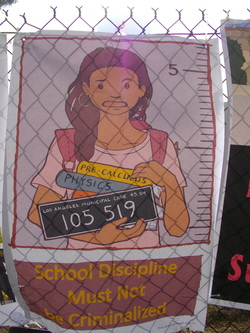
Graduate Them, Don’t Incarcerate Them! The Movement to Keep Young People in  School

The problem isn’t a secret: California schools suspend more students than they graduate, tracking them to jail instead of to success. But Ramiro Rubalcaba was surprised when he found himself being part of the solution.


Rubalcaba told his story at a forum on school discipline held in Los Angeles
on September 10, sponsored by the California Endowment, the Office of the Superintendent of Public Instruction Tom Torkalson, and the Office of Attorney General Kamala Harris.

Two years ago, when Rubalcaba was assistant vice principal at Garfield High School, the school was suspending 600 students a year and was challenged to bring those numbers down. He didn’t see how it would be possible to do so and still maintain order on a campus unfortunately known for violence, gangs, and drugs. After all, the approach throughout the US has long been to get unruly
kids out of the classroom so that teachers can teach.

 “We were forced into these meetings,” Rubalcaba said, but “OK, we’ll comply.” This meant professional development for faculty and staff; meetings with students, parents, faculty, and law enforcement. One of those law enforcement sessions spun his head around as he watched a video interview and heard the words of a boy who’d killed his parents and then taken a gun for an attack on his school: I’d rather be wanted for murder than not wanted at all.

Rubalcaba was convinced the school culture had to change. Disruptive students couldn’t be made to feel that everyone would be better off without them. All students and their parents had to feel welcome and wanted in an environment where every effort would be made to keep kids in school instead of pushing them out.

It should seem obvious: when kids miss days of school for suspensions and court dates, they fall behind. When they fall behind, they are bored and frustrated in class and more likely to get in more trouble and be punished with more suspensions or to drop out altogether.

“We took suspension off the table,” Rubalcaba said. He then led efforts to implement a program of Positive Behavioral Interventions and Supports. Together, the entire school community worked on a document setting out expectations about behavior and the consequences of violations. The students themselves told the administration where on campus fights were most likely to break out and which sites most needed adult supervision. Instead of kicking a kid out of school for an offense, the violation is now seen as an opportunity for the young person to learn from his or her mistake–and for faculty and administration to learn more about the young person and the roots of the inappropriate behavior.

Garfield suspensions went down from 600/year to a single suspension from 2010-2011. (That one case was mandatory under the state education code because the student had carried a box cutter to school.) Keeping all those presumed troublemakers in class didn’t lead to disruption. Instead, achievement test scores went up.

Garfield’s success led to media attention and the doubters (“haters,” in Rubalcaba’s word) came to campus expecting to find fudged statistics and a troubled campus. “Those haters became believers.”

Overall, according to school board president Monica Garcia, the Los Angeles  Unified School District has cut suspension rates in half, in part thanks to a new policy that was adopted after tireless advocacy by community groups: students are no longer cited for truancy when they are en route to school or arriving just after the bell.

That’s the good news.

Not good enough. “Thank you,” Garcia told the young people and community advocates in the audience, “for not being satisfied with our current status quo.”

The reality remains that 18,000 students are expelled from school each year in California and more than 700,000 suspensions are reported.

 As LAUSD Superintendant John Deasy has acknowledged, “Multiple suspensions basically signal, Don’t come here anymore.”

 The California Endowment, a health organization, cares about school discipline because suspended students are more likely to drop out and the Endowment sees high school graduation as a “protective health factor.” Going to  jail usually leads to negative health.California Supreme Court Chief Justice Tani Cantil-Sakauye has frequently explained that being suspended triples a
young person’s likelihood of contact with the juvenile justice system within the year. Brian Nelson, speaking at Monday’s event on behalf of Attorney General Harris explained education is “a powerful tool for reducing violence” as truancy is an “on-ramp to becoming a victim or perpetrator of crime.” Harris recognized the importance of keeping kids in school when she was San Francisco District Attorney and noted that “94% of San Francisco homicide victims under the age of 25 were high school dropouts.”


But in California today, young people are still being arrested and taken from classrooms in handcuffs for nonviolent offenses. Kids entering the juvenile justice system–for offenses as trivial as being tardy–get an inadequate education on the inside and are often denied re-enrollment in the public schools when they come out, leading to a lifetime of anger, frustration, lost opportunity, and an increased likelihood of criminal behavior.

 Do we understand that when young people are repeatedly shamed and humiliated, we plant the seeds of aggression?

Forty percent of chronically truant children are in elementary school, losing the basic foundation in reading, arithmetic, and social skills. “We need to target their families,” said Nelson, “not to punish them but to find out what resources the parents need to get the kids to school.” At a time of budget cuts, where will those resources come from?

California still has one of the highest rates of push-out in the nation. Youth of color–especially African American males–receive harsh discipline at a much higher rate than their white peers even when the discipline history and offense are the same. In general, girls receive more lenient treatment than boys, except for African American girls.

 “We ought to be outraged as a country,” said Russlynn Ali, Assistant Secretary of Civil Rights at the US Department of Education. “Discipline sits within a larger context of inequity.” Where you see racial disparities in disciplinary patterns, she said, you also see other problems. The neighborhoods with high harsh discipline rates tend to be low-income with students of color and they also more often fail to offer the courses required for college admission. “Who gives students access early and gives them what they need to succeed?” she asked. “Who has access to gifted and talented programs?” She wasn’t just talking about Advanced Placement courses either. Many schools with a predominantly low-income African American student body fail to offer algebra in
7th and 8th grade. When the courses are offered, “African American students pass at the same rate as anyone else,” she said.

From the statistics collected by the Department, it’s become clear that minor offenses are punished more harshly when the student is black. Along with the numbers, Ali cited examples from around the US: A chronically tardy white student gets a conference at school; a black student tardy for the first time is suspended. Teachers and administrators often try to understand the white students and figure out why the kids are having the problem. With students of color, there’s an immediate jump to punishment. A black youth blurts out a bad word in gym class and is immediately suspended while at the same school, a group of white girls curses at the teacher and disrupts the class. Their parents get a phone call.

Is there an unconscious assumption that black parents wouldn’t care? Edward Madison, a South LA parent leader with the CADRE community organization, told the gathering “Parents–not just kids–are pushed out. Parents and caregivers have the right to participate in their children’s education.” But African American parents who do try to participate in school are told directly it’s their own fault if their kids “act out and don’t succeed.” Feeling unwelcome, they stop participating.

Rob McGowan, CADRE’s associate director of organizing, pointed out that most suspensions in California have nothing to do with drugs or violence. “Willful defiance is largest single reason for suspension”–a term that lends itself to subjective interpretation and bias.

“We want a moratorium on non-serious suspensions,” said Madison. “Replace a life sentence with life lessons.”

 CADRE called for access to disciplinary data broken down by race, ethnicity, disability, language, and gender.

Statistics are valuable consciousness-raising tools. “Teachers don’t realize their split-second decisions are leading to discrimination,” said Ali, “until they see the aggregate.”

“You can’t apply a race-neutral solution to a race-based issue,” said Curtiss Sarikey of the Unified School District of Oakland, “a city that has a lot of pain, a lot of hurt, a lot of violence.” He explained that school superintendent Dr. Tony Smith considered specific needs in implementing the Thriving Students Model. For example, Manhood Development Classes designed for young African
American men almost eliminated suspensions and absenteeism among those attending and also upped their GPAs.

 Although students with disabilities presumably have extra procedural protections, other disturbing data shows they are actually suspended at a higher rate.

And there’s a category that gets overlooked entirely in the statistics.

“As LGBTQ youth are more openly out in the school, increased visibility has meant less safety” said Geoffrey Winder of the Gay Straight Alliance Network. As a result, students may get in trouble for carrying a weapon they believe they need for self-defense. There’s bias on the part of administrators and, too often, gay students who have not come out at home find their parents are
notified of their orientation by the school administration, resulting in rejection, violence, kids forced to leave home.

Ali added that LGBTQ students are suspended when administrators see gender nonconformity as willful defiance or disruption.

Brandon Serpas, a youth leader, related his own experience as a bullied gay student. When he was harassed in class, the teacher ignored it. With the school supposedly committed to anti-bullying efforts, he went and talked to the assistant principal. The result: the offending boy was suspended, much to Brandon’s dismay. “Suspension doesn’t help harassment or bullying. It doesn’t address the attitudes.” The boy was back in school three days later, and Brandon had real reason to fear. What he had wanted was a program of restorative justice and a way to teach respect.

Restorative justice asks Who was harmed? What are the needs and responsibilities of all the parties? How do all the people affected work together to address needs and repair harm?

 Programs based on this model are being used successfully in some California schools. According to MaryJane Skjellerup of the Youth Leadership Institute in the Central Valley, “Students want to be listened to, to tell us why they struggle with behavior problems. Each student has different needs,” she said, but “they all want to succeed.” The discipline model now in place in the Fresno Unified School District allows opportunities for student voices. They have the chance to learn from their mistakes and be held accountable. The focus is on improvement. Students are part of the solution, asked for their input on making a plan to make right what went wrong. The program addresses the needs of victims and also educates community leaders that harsh discipline leads to dropping out.

Administrators throughout California want to do better. On September 10, EdSource, an independent nonprofit research and policy organization, released a survey of school districts covering about 2/3 of all students in the state. The report documents that administrators overwhelmingly want to address discipline by hiring more counselors and support staff rather than by increasing security measures. They recognize and are concerned with the disproportionate effect of harsh discipline on students of
color. One in five administrators want more discretion, having regretfully expelled a student because the state education code mandated it when they would have preferred a different approach.

In the 90′s, said Manuel Criollo of the Labor Community Strategy Center, “there was robust funding for police in schools.” Today, how do we fund counselors instead while support services outside of school in the community remain underfunded and inadequate?

Laura Faer, education rights director for Public Counsel Law Center, pointed out that schools receive funding based on the number of students in attendance. Keeping students in class means more resources for the school. In fact, she said, a bill that would have taken suspension off the table completely in California died in the Appropriations Committee on the grounds that more
students in school would cost the state more money. (What are our priorities?!?!)

The audience, including at least 50 young people who attended after school, heard from a number of their peers, including Camerian Ponn. The American-born son of survivors of the genocide in Cambodia, Ponn told of growing up in Long Beach in a community affected by poverty and trauma. His cousin died in his arms, victim to a driveby shooting. His brothers and sisters were all dropouts and told him he would be the same–a prediction that seemed likely to come true when he was kicked out of high school for failing to bring a book to English class one day. Though Ponn was later able to earn the credits he lacked at a summer alternative school and is now in college, he looks back on high school as a place where he felt “unmotivated, unloved, and depressed.”

School is too often “a minefield of laws you can break,” said Criollo.

 Schools need to rethink zero-tolerance policies and stop abdicating their responsibility for the young to the police. The criminalization of school-based offenses, usually nonviolent in nature, helps drive the juggernaut of mass incarceration that is crushing low-income communities of color. If we want young people to develop concern for others and values based in respect and fair play, school has to become a model of fairness, caring, and respect. When that happens and schools offer safety, welcome, respect, and nurture, more young people growing up in poverty and in violent environments will find refuge and sustenance inside those doors.

 *                   *                   *                   *                    *

 As part of the movement to reform school discipline, the state legislature has passed seven common sense bills that now sit on Governor Brown’s desk awaiting signature. Brief descriptions follow:

 SB 1235: Schools with high suspension rates are encouraged
to adopt behavioral strategies and attend one of three annual forums to learn
alternative methods.


AB 1729: Strengthens existing law that requires, in most
circumstances, that suspension be used only after other means have failed.


AB 1909: When a youth in foster care is pending explusion or
harsh discipline, bring to the table the adults responsible for that child’s
welfare.


AB 2242: Students cannot be expelled from an entire school
district for willful defiance or disruption of school activities.


AB 2537: Provides some discretion for a principal or
superintendent not to expel if circumstances don’t warrant it; possession of
imitation weapon or over-the-counter or prescription medication will no longer
be automatic grounds for expulsion. (Discretion would have prevented a recent
insane outcome. A student talked a classmate into handing over a knife, then
took the knife to the principal’s office to turn it in and request help for the
classmate. After being praised, the good citizen received a mandatory suspension
for being in possession of the weapon.)


SB 1088: Prohibits schools from denying enrollment or
readmission to a youth who has had contact with the juvenile justice system.


AB  2616: Calls for schools to address root causes of truancy and create an
attendance plan rather than immediately referring the matter to law enforcement.
It also provides administrators with discretion as to whether to involve the
juvenile justice system. (Right now the Court takes automatic jurisdiction after
the 4th offense.)


To express an opinion on these bills, call Jerry Brown’s legislative affairs
office at 916/445-4341. Or download letters of support
here
.


Elizabeth Spann Craig, thanks for posting this today at your site, Mystery Writing Is Murder.
The Terms of Success—Guest Post by Diane Lefer
  
 I think it was Muriel Rukeyser who said offer your work to publishers. A writer must never submit. Never never never
submit. And oh! I know the righteous anger of the disrespected author! Do I complain? Oh yes, guilty as charged. But some years back, with two collections of literary short stories in print, I was invited to teach a class and give the keynote address at a writers conference. Time to reap the rewards!

Now I did realize if a writers conference was having me as their keynote speaker, it couldn’t be the #1 conference in the
world. And while they would cover my airfare and hotel, no, they couldn’t pay me. But of course I said yes. I got up at 3:00 AM to make my flight (with no food), and was met at the gate when I landed. So far, so good. I collected my luggage. My battered old
suitcase had fallen apart in transit, everything was spilling out, and my guide set off at a trot in front of me while I tried to swipe underwear off the floor and hold the sides of the suitcase together with everything I hadn't lost along the way inside it. When I was dropped me off at a beautiful hotel outside of town. I thanked my guide and said I’d see her in the morning. “Oh, no,” she said
with what seemed like true horror. “I would never attend the conference.”

 Inside the hotel, people welcomed me and explained they were having a reception at 7:00 - freshen up and come on down.
The reception which lasted till 11:00 p.m. was me paying for my own drink and no food. An elderly woman told me at great length about a trigonometry problem she couldn’t solve. Finally, I said how wonderful it was she was back in school. Oh, no, she said,
this happened many many years ago. Next thing I knew I was awakened in my room at 4:30 AM by horror movie thumps down the hall which turned out to be the Wall Street Journal hitting each door.

At last it was late enough to head downstairs and try to rustle up a cup of coffee. (No coffee-maker in my room) But before I
got my fix, this guy comes over and says he’s supposed to introduce me and then follows me around telling me all the problems in his marriage. The printed program had contradictory times and places for my class, so people didn’t know what time or where to go. A handful trickled in. My introducer spoke about himself--luckily, not about his marriage--for about 15 minutes after which he
announced, “And now! Diane Leffler!” (which is close, but no cigar, when it comes to my name).

 OK, I realize I’m not being generous in spirit. But really, after a woman told us all about her ex-husband’s suicide, he actually slapped his thigh and started telling suicide jokes. (Till then, I didn’t know there was such a genre.)

 I didn't give up. Really. I really tried really hard to get people to explore the emotions of their characters.

 “I can’t do that,” said one woman, “All of my characters are dogs.”

 “Don’t your dogs have personalities?”

 “Oh, no,” she said. “They’ve all passed away.”

 I was ready to pass away from hunger. A kindly woman took me out to a corridor and explained we don’t really need to eat. It’s
possible to get all the nutrients you need from the air. She led me in a bout of breathing exercises but I was still hungry.

At last, the luncheon banquet and my keynote address. I didn’t get to eat because I was at the podium, talking. Just as well.
From what I could see, the other participants were served a sandwich of questionable tri-color (white, brown, and green) luncheon meat rather like what I consumed during a stay after a protest demonstration at the 77th Street holding
cell in SouthCentral where another prisoner led us in singing the score to
the Sound of
Music.


My stomach growled, but inside my head those
voices rang, raised in song, to remind me: The writing itself-- the freedom to
express myself as I want and in the best way that I can--is surely one of My
Favorite Things.


Picture
On  Characters: Dual Capacities
  
A  Craft Short from: Diane Lefer published today in Hunger Mountain online.

 SEESAW
 .
It must be eight years since A Tale of Love and Darkness was published in English and Israeli author Amos Oz spoke at Vroman’s Bookstore in Pasadena. In his memoir, Oz writes about the troubled marriage of his parents as well as the conflict in his country between Jews and Arabs, Israelis and Palestinians. At the bookstore, he explained that in telling these stories, he had tried not to take sides: “I’m no longer interested in the conflict between right and wrong, but the conflict between right and right.”

 His words startled and excited me then and came immediately to mind as I watched Asghar Farhadi’s Oscar-winning film from Iran, A Separation.

In the film, every character tries to do the right thing. For guidance, they look to religion, to secular law, to ethical standards of family loyalty, human rights, ideas of reputation and friendship. Yet every time a decision is made, no matter how sincerely,
someone gets hurt and something goes awry. There are no guns, no car chases, and yet the tension in this film had me on the edge of my seat.

Both Oz and Farhadi come from the Middle East, from societies that are polarized. Maybe that explains why both have used art to question the demonization of the Other and of those who disagree. But American society is also polarized. Except for Andre Dubus
III’s House of Sand and Fog which concerns—coincidentally?—an Iranian man, I can’t think of an example from our literature, including my own fiction, that recognizes the legitimacy of opposing claims. Is such complexity beyond us? If fiction must (as we’re often told)  involve conflict, must it mean the clash between Good and Evil?

What if I drop the distinction between protagonist and antagonist? Instead I see two people on a seesaw, only momentarily in balance. When one goes up, it’s unavoidable that the other will go down but they are in this dynamic together and I must respect them both.

Look at the last story or memoir section you wrote, or the last short story you read. Did you (or the author) make it clear which character was right? How might the piece change if no one had a monopoly on justice?

When there’s a character I really don’t like, I try to keep in mind that everyone has dual capacities though we don’t all (or always) act on them. This exercise helps me:
 
Close your eyes and imagine.
What experience makes you feel empowered, expansive, strong? Then, what does it feel like to be insignificant, unnoticed? Go into your memory to find the experiences that have triggered these feelings. Now think of your characters and imagine what triggers these emotions in them and how they express those feelings in action. Imagine your characters feeling greed/generosity, love/hate,
fear/security, rage/forgiveness, truthfulness/deceit.


Our favored character isn’t a
saint, and the character we don’t like shares our humanity.


~


*Warning: Seesaws, now
considered a safety hazard, are being removed from playgrounds all around the
country. Use this metaphor at your own risk.


Abbe Land
Abbe Land
In today's LA Progressive:

Abbe Land, West Hollywood Mayor Pro Tem, doesn't want activists to think of "lobbying" as a dirty word. "In the purest form, it's about educating and helping elected officials understand the issue," she told more than 100 community members attending the July 25th workshop, "Your Voice: Learning to Lobby for Social Change," organized by the Advocacy Committee of the National Council of Jewish Women/Los Angeles.  "Paid lobbyists can keep knocking on your door till you let them in, keep  telling you their side, their side, their side--till it's possible forget about the other side." Progressive organizations lobby, too, "to move our agenda forward," she said in her keynote address, but don't have the resources to keep up that kind of constant pressure without the help of the individual activist. The role of citizen lobbyist is crucial.

In the breakout sessions that followed, community members got tips about individual activism while much of the discussion focused
on the role of organized nonprofits as well as informal ad hoc advocacy groups. 
 
(While 501(c)(3) nonprofits can lose their tax-exempt status if lobbying takes more than 5% of their time and resources, they are not
banned entirely from approaching officials on behalf of specific legislation. Good information on how to navigate rules and restrictions and maximize lobbying to the full extent of the law is available at the website of the organization Alliance for Justice.)

Picture
Legislate? Or Educate?

 There's no limit on 501(c)(3) organizations (or anyone else) when it comes to campaigns to educate officials about issues.

 Emily Austin, who facilitated the workshop on "Policy Process 101: Transforming Ideas into Policy," explained that education must sometimes precede any attempt to make policy given the many obstacles to
  getting a bill into law. Even if you can get legislation introduced, it's
  likely to die in committee unless the ground has been fully
prepared.


To illustrate how this might work in real life, Austin
shared her experience addressing teen dating violence in her role as Director of
Policy & Evaluation for Peace Over Violence, a nonprofit dedicated to intervention and prevention of domestic violence and sexual assault. Through its work with survivors, POV was aware that many teens were victimized but when staff went to the broader community, they found parents insisting their kids didn't even date so couldn't possibly be affected.
 POV collected statistics and reports to show the prevalence of the violence and began to collect powerful personal stories as well. 
 
"Think about who your allies might be," she said. "Unlikely allies, too." Progressives sometimes overlook the support a cause
might get from groups--in this case, law enforcement and prosecutors--that aren't always in agreement with our values. 
 
You also need to identify the opposition and what their arguments might be. An Orange County politician, for example, was opposed to any discussion of dating violence because dating implied sexual activity. In today's economy, you can expect arguments about funding, so think about possible resources and be ready to make the argument--with specific figures--that
spending money now will prevent higher costs later.

 Determine your venue, Austin said. Do you think the issue is best addressed on a federal, state, local, or organizational level?
Once you know your venue, find a champion there. Whether a bill needs to be shepherded into law or a regulation or policy needs to change in a bureaucracy, someone has to work toward this goal with almost single-minded focus and push hard for it in a knowledgeable and articulate way. 

POV connected early on with Steve Zimmer, a Los Angeles teacher and counselor for 17 years, who knew firsthand that students
were suffering abuse. When he was later elected to the school board, he became an ideal champion--committed, able to speak at a press conference in an entirely credible way. He didn't need to have talking point provided to him and was able to answer any questions with ease. (As Abbe Land pointed out, a paid lobbyist has to be prepared because they get fired if they don't know the issue very well. We have to be sure we are every bit as knowledgeable when we speak to people in power.) In October 2011, Zimmer got the school board to pass a unanimous resolution in favor of a prevention program for the city's public schools. Though no funds have been identified yet to implement such a program or the curriculum prepared by POV, the problem--after years of educating the community--is at last officially recognized. As Austin said, "It's on the map." Even this limited progress to the goal took years while POV did the research, developed and nurtured relationships, and prepared the ground with public awareness.

For now, the organization continues to educate peer leaders who can talk to other teens. And while you're figuring out how to
 influence others, Austin said, look at your own organization. Is it living up to its stated goals? For example, when people think of teen dating violence, the common assumption is this refers to girls who are victims of boys. Austin said POV looked to be sure its own board and policies were friendly to LGBT teens and youth who were questioning their sexuality and/or gender.

Whatever your cause, remember you need to raise community awareness and support before trying to promote a bill. Sometimes,
Austin warned, the community may  get passionately behind a cause after a particularly terrible event. These laws sometimes go through quickly--too quickly. "Legislation created after one specific set of facts--such as laws that tend to be named after a survivor or victim" are often poorly drafted "without thinking of unintended consequences." Think through any proposed bills or recommendations with care.


Picture
Everyone Has a Role

Serena Josel, Director of Public Affairs at Planned Parenthood Los Angeles, spoke on "Mobilizing Your Base: Grassroots and Grasstops Lobbying"

 For legislative advocacy, she said, you need three ongoing components that work together: a policy analysis team to study a bill and consider what real-life impact it would have; a media team to communicate these impacts to the public; a lobbying team of paid lobbyists if possible, plus the grassroots and the grasstops, the latter being members or allies of your group who are prominent in the community or have special relationships or access to decision makers because they are big donors or as colleagues or former staffers or through, for example, family, friendship, business.

 "Last spring when Congress tried to defund Planned Parenthood," she said, "what did we do?" First, the policy team warned the organization to take the threat seriously. Though the same amendment had been offered in Congress every year for six years, it never before had a chance of passing. This time, the policy team put out the alert that "it had legs." The media team got to work with radio and television interviews and social media to make the buzz louder and get people engaged.

 As for the grassroots lobbyists, how much could they accomplish here in LA where Planned Parenthood enjoys strong longterm
support from our elected representatives? First, whatever your cause, if you've got a compelling personal story, an official who's already on your side can use it in working to convince others. Then, Los Angeles grassroots activists turned to technology. They phoned sympathetic voters in targeted states, told them what was happening in DC and said "Your senator will be one of the deciding votes. Will you let me patch you into their office right now?" In this way, people power in Los Angeles generated calls to senators all around the country. "We won on the federal level," Josel said, though Planned Parenthood is still under attack in eight states.

Grassroots volunteers have also fanned out with cell phones on college campuses and at farmers markets, talking to people and
inviting supporters to make calls on-the-spot to elected officials.

As for the grasstops, Josel passed around copies of a sample chart set up to list all the decision makers relevant to an issue. After you poll the organization's board and active members, you fill in the blanks on the chart: who has a personal connection to each decision maker; who is a professional contact; who knows someone who is an indirect contact and in those cases, fill in that person's name and the nature of the relationship. You can then identify who is best suited to make the approach. 
 
Don't ask your grasstops to call everyone they know, Josel advised. Choose targets with care. Track what happens. Some  grasstops turn out to be have more clout than they expected; some less. 
 
Before any contact is made, the grasstops spokeperson should be carefully prepared. Their relationship means they are likely to have a real back-and-forth conversation with the decision maker so they'll need to know their stuff. The organization can follow up later with additional information if needed and, of course, with thank you notes.

 Decision makers who support you need to be thanked whenever they do the right thing with their vote, Josel said. Just because a person's belief system matches up with yours, doesn't mean they'll always want to go out on a limb for you, especially in an election year. Let them know that constituents have their back by sending a note or a even a photo of a large group of people holding up a big thank you sign.

Keep your grassroots people engaged with updates and reports of progress. 

Tips for Individuals

 Citizen lobbying is most effective when the decision maker can see you face-to-face (in their district or Capitol office or at a town hall meeting) or at least hear your voice on the phone. Meeting with an official's staff members is just as valuable.

Personal letters get more attention than petitions or mass emails. Snail mail shows a higher level of commitment than email. But keep in mind: Physical letters sent to local district offices will rarely be subject to delay but in DC, mail goes through security screening and can take several weeks to reach the recipient. For an urgent matter or when a vote is imminent, phone calls and personally composed emails are necessary. 
 
Use personal language, Josel said, not political jargon or bumper sticker language, e.g., talk about pregnancy and families, not
the opposing camps of pro-choice and pro-life.

On-line petitions may have some effect if the numbers are huge and come from appropriate zip codes.

Think about visual impact. If you're part of a pre-printed postcard campaign, save the cards and deliver them all at once. A  thousand cards dumped in a legislator's office can't be ignored. The same number trickling in over the course of a year or two can be overlooked.

If your letter to the editor is published, send copies to relevant decision makers, or, a participant suggested, bcc (send blind
copies) to the people you want to influence. That way, they'll know your opinion and that you cared enough to write even if the letter isn't published.

Facebook and Twitter campaigns tend to work best with corporations concerned about their image and their brand and are less
 effective when targeting elected officials. It's worth tweeting a representative who's known to use Twitter a lot. If you catch him or her during a particularly boring committee meeting, you may have the chance for an extended exchange.

A Last  Word

 Matt Leighty, who has worked as a lobbyist and teaches a graduate-level course on "Lobbying and Policy Change" at Pepperdine
University offered a workshop on "The Art of Persuasion: Winning Them Over," focused on preparing and delivering oral arguments. As participants could only attend two of the three breakout sessions, I missed his presentation. Which leads to my own tip to fellow activists: Don't beat yourself up if you can't do everything. 

But here's something you can do. The meeting ended with:

 Action Alerts

 Contact Congress to support:

 1. The reauthorization of the Violence against Women Act (VAWA) as approved by the Senate (S. 1925) rather than the House version (H.R. 4970) which was designed to undermine or deny protection to immigrant women (including mail-order brides), Native women, students on college campuses, and LGBTQ victims. 

2. The Fair Minimum Wage Act which would raise the minimum wage in three gradual steps from $7.25 to $9.80/hour by 2014. Get
  your representative on board as a co-sponsor.

If you need help finding your members of Congress and their contact info, call the Capitol switchboard at (202)224-3121 or go
online:

http://www.house.gov/representatives/find/ and
         
http://www.senate.gov/general/contact_information/senators_cfm.cfm/

 For California actions, contact your state senator to support these Assembly bills being considered by the Senate:

 1. AB 2348 which would allow RNs to dispense birth control to women who have no risk factors. Today thousands of women who
  want contraception are turned away at health centers as there aren't enough doctors to see them. (If you make this call, please let Planned Parenthood know how it went by emailing grassroots@pp-la.org/)

2. AB 593 and AB 1593 which would aid incarcerated battered women who were unable to present a domestic violence defense at the time of a petition for habeas corpus and would give them a chance to present this evidence effectively during the parole  process.

  To find a California state senator:
http://www.leginfo.ca.gov/yourleg.html