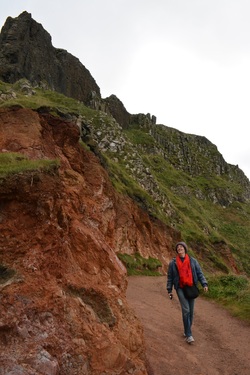
 photo by Evanne Nowak. It's me on the Red Trail at Giant's Causeway.
 Doug Glover was good enough to publish this account of our work and my own uncertainties in the February 2014 issue of Numero Cinq. Which you can read here.
|
photo by Evanne Nowak. It's me on the Red Trail at Giant's Causeway. Doug Glover was good enough to publish this account of our work and my own uncertainties in the February 2014 issue of Numero Cinq. Which you can read here.
I'm looking forward to a rehearsal via Skype with actor Lorenzo Montanini in Rome, after he's rehearsed with director Jeremy Lydic in New York. Lorenzo will be performing my short interactive play, Ave Atque Vale, on November 12th as part of Around the World, a whole day event produced by global directors collective, The Internationalists. More info on the intriguing program here: http://theinternationalists.org/ATW11.html
My piece in today's Hollywood Progressive:
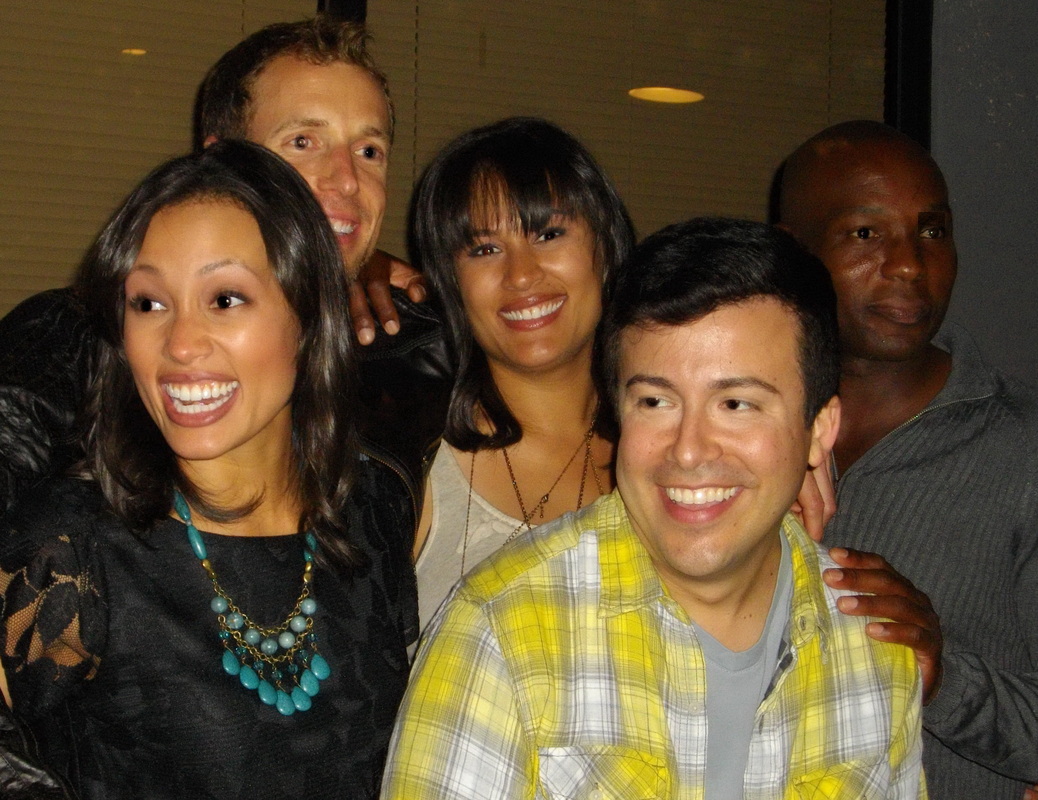
Adeye Sahran fell in love with Nicky Silver's dark farce, The Maiden's Prayer, when she was a student in the theatre department at USC. The role of Libby--the volatile, caustic, hard drinking romantic who accidentally becomes a prostitute while suffering from unrequited love--seemed perfect for her. Except for the fact that Silver is known for satirizing the world of gay, Jewish and WASP characters in New York City and its suburbs. Libby, like all of the play's characters, is written (or presumed) to be white. Sahran isn't. It's not as though she doesn't get work. There was the all-black production of Medea; performing in the Scottish play for kids on Skid Row. More Shakespeare (Othello, Coriolanus, A Midsummer Night's Dream). More Greeks: Lysistrata. (Why is it that casting without regard to race is less controversial when the play is centuries old? Is Shakespeare as imaginary to us as sci-fi?) Native American and African American playwrights keep her onstage. Last year, playing the lead role in Fabulation or the Re-Education of Undine (by Pulitzer-Prize-winning black playwright, Lynn Nottage), the LA Times raved about the "winning, full-throttle performance by Sahran, who nails the play’s extremes of satire and heartbreak." Sounds like she'd make an excellent Libby. Sahran couldn't get the role out of her mind. And why should she? Is it really necessary for Nicky Silver's plays to be cast with actors reflecting his own ethnic background? Or for most so-called "diversity initiatives" to concentrate actors of color in race-specific projects? Just for fun, Sahran and Stephan Wolfert, the actor/director who'd performed with her in Macbeth, arranged a staged reading of The Maiden's Prayer. Sahran invited her real-life sister, actor Annie Lynne Melchor, to read the role of Cynthia, Libby's sister and antagonist who marries the love of Libby's life. They rehearsed. They read. That was supposed to be the end of it, but "This is your dream," Melchor said. "Let's make it happen." Karen Harris signed on as co-producer and people pledged support. Sahran founded Phoenix Rising and the group got nonprofit 501(c)(3) status in what must have been record time. The mission? Not just to bring The Maiden's Prayer to the Atwater Village Theater (in a production that swings from riotous and frenetic to sobering under Wolfert's direction) but to be an ongoing presence in the Los Angeles theater scene, dedicated to casting without regard to ethnicity, race, age, or type. If you're not in the business yourself, you might assume that directors just want the best actors they can get. Here's a reality check: when Sahran sent her needs to a widely used breakdown service through which producers let actors know about auditions, she was told, "We can't post this." She had listed the characters without specifying age, race, or physical description. "But that's the whole point," she said. According to Melchor, many casting directors don't know what to do with actors who don't fit neatly into a racial category. She trained in classical theatre, loves the stage, and makes a living in television, but says it's hard to even get an audition "when they look at you and don't know what to think." (This, in spite of the fact that America's mixed-race population is one of our fastest growing demographics.) Ray Paolantonio loves everything Nicky Silver ever wrote. He's a white guy from New York--"I relate to his work"--but after a recent audition for a Silver play, he didn't get the role because, he was told, "they wanted someone blond." Phoenix Rising cast him as Paul, the gay man who, like Libby, is helplessly in love with Taylor, and who becomes Libby's best friend. John Ruby actually does match the tall blond type the script had in mind for the role of Taylor, but he turned in a great audition and got the part. No reverse discrimination here. Eric Davenport (Andrew in The Maiden's Prayer) doesn't hesitate before naming his dream role. The African American actor has been on the Broadway stage in Ragtime as well as performing regionally and in national touring companies. He's got the chops for musical theatre but unless attitudes change, will he ever get his wish: to audition for Tony in West Side Story? And so, as soon as the company website went up, Phoenix Rising put out the word, inviting local actors to suggest plays that would give them the chance to take on roles for which they've found themselves automatically out of consideration. Sahran believes audiences relate to the humanity of the characters and to the talent of the actors, not to their race. That doesn't mean race disappears. The audience may find meaning in the actor's race even when it's not in the script. In 2007, S. Epatha Merkerson received raves as Lola, the Midwestern housewife (previously assumed to be white) in Willliam Inge's 1950 play, Come Back, Little Sheba, a production that moved from the Kirk Douglas Theatre here in Los Angeles to Broadway. One critic thought that an interracial couple in the smalltown 1950's environment would suffer such isolation, their plight would help account for the intensity of the characters' frustration. Merkerson herself noted in an interview that in the script Lola has been disowned by her father. Could her marriage to a white man be imagined as the cause? In The Maiden's Prayer, when a white actor plays Andrew and describes his latest lover as the most beautiful man he's ever seen because he looks like a Nordic god, few white audience members are likely to question society's standards of beauty. But when Davenport, a black actor, speaks the same lines, the audience may feel uncomfortable enough to hold those standards up to scrutiny. The challenge addressed by Phoenix Rising is not exclusive to LA. In New York which is, like LA, one of the most diverse cities in the world, during the last five years, 82% of the roles on Broadway were filled by white actors. As a further example, while Asians Americans are the fastest growing minority group in New York, 12.6% of the city's population, they were cast in only 2.3% of all roles on all New York City stages, not just Broadway. Melchor points out that typecasting is not only about race. She would love to play Sylvia, the canine character in A.R. Gurney's play of the same name. "I'm a dog person," she says. She loves dogs and she wants the chance to embody one onstage though people tell her she has a feline presence and doesn't look the part. But transformation: Isn't that what acting is about? "We cast without boundaries; all ethnicities and ages encouraged to audition." Saturday night, when the lights came up on Phoenix Rising's inaugural production, Los Angeles theater took a welcome step in the right direction. You have to wonder. Audiences had no problem accepting Merkerson, nominated for a Tony in what had always been perceived as a white role. Why didn't her success start a trend and open doors? More to the point: When will contemporary theatre catch up with the actual composition of the contemporary American family? When are we going to stop referring to color-blind casting as "nontraditional"? Given today's society, a multiracial, multiethnic cast doesn't look experimental, but realistic. The Maiden's Prayer October 8th through November 13th, 2011, Thursday-Saturday at 8pm and Sundays at 2pm and 7pm Atwater Village Theater, 3269 Casitas Avenue, Los Angeles, CA 90039 Tickets: $18 on BrownPaperTickets.com; $20 at the door. www.PhoenixRisingTheater.org tatiana de la tierra is in Mexico now, celebrating the publication of her newest chapbook (which i can't wait to see), but while she's there, she posted on La Bloga the essay in form of a letter I sent her when I returned from Barrancabermeja in May.
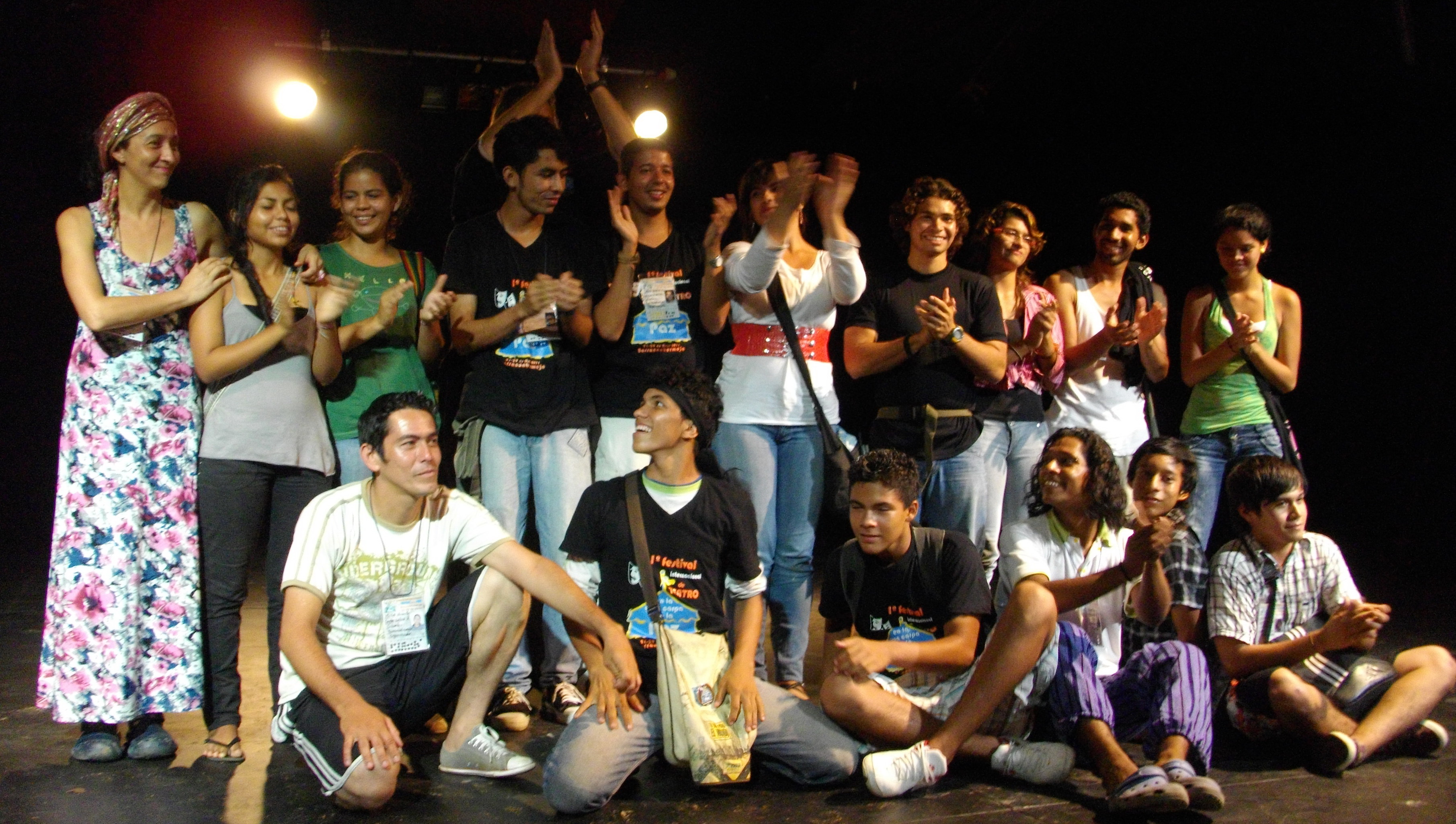
In Barrancabermeja, Colombia you don't have to moisturize, there's so much petroleum in the air. They bathed your brow in oil... goes a line from the city's own anthem (to be sung at public events following the national anthem, and the himno of the departmento de Santander) and they say nothing happens here without the permission of Ecopetrol, the state-controlled oil company, (though the degree of control can be questioned as each aspect of oil extraction and refining and shipping in Colombia seems to have its own financial structure with the Colombian government owning shares here and there and transnational corporations controlling projects and then there are the shares sold to the public so that it remains a great mystery who is really in charge of anything). Nevertheless I guess I would not have found myself in Barranca if Ecopetrol had not given its blessing to the Primer Festival Internacional de Teatro por la Paz. Tatiana, you wanted to know how it went for me in tu tierra, in a part of tu tierra where you have never been, and still overwhelmed by everything I saw and heard and experienced during the past two weeks (May 20-30, 2011), I am trying to organize my thoughts enough to tell you. Before I left for Colombia, all I knew (from the internet) was that Barrancabermeja was infamous for massacres, disappearances, street battles between guerrilla armies and rightwing paramilitaries, oppressive heat and humidity, characteristic odor, and mosquitoes carrying chloroquine-resistant malaria. How did such a place--which only recently got its first movie theatre open to the public--become the site of an International Theatre Festival for Peace and where did I get the thoroughly presumptuous idea I could lead writing workshops there in Spanish? So let me introduce you to: Yolanda Consejo Vargas, dancer and theatre artist born in Mexico, and her husband Italian-born director Guido Ripamonti. In 2007, they found themselves in Barranca, in the low-income neighborhood, Comuna 7, and there they found a community that had organized itself to resist violence and oppression. They saw the people of Comuna 7 reweaving the social fabric that had been shredded during years of terror and trauma, people committed to healing social wounds, educating their children for social responsibility and for peace. Inspired, Yolanda and Guido moved in and decided to stay. They began offering classes in theatre and literature and dance and more as well as training their students to go into primary schools to share what they'd learned. A year ago, Yolanda had the idea that the Centro Cultural Horizonte Ciudadela Educativa should organize an international festival. Artists from around the world would present performances and also teach. There would be activists and academics offering presentations and discussion groups, everything open free to the public, everything aimed at advancing a culture of peace. Out went the invitations, riding through the ether on little more than faith. The acceptances came in: from all over Colombia, from Mexico (so many in fact that some of us began to refer to Barrancaberméxico), from Venezuela, from Argentina and Chile, from France and Italy and Germany and Israel, from an Iranian exile in Canada, from my frequent collaborator Hector Aristizábal (Colombian living here in the US), and from me. Hotels offered rooms for the international visitors. Social organizations such as the Corporación de desarrollo y paz del magdaleno medio and of course Ecopetrol pledged support. Lacking a theatre space, Yolanda and Guido had a huge tent--one that could accommodate 800 people--set up on the lawn in between the city's one library and the university. The university, the policlínica, the teacher's college, the high school, the vocational training institute offered auditoriums and classrooms for the lectures, workshops and conferences. Such an event had never before been seen in Barrancabermeja. Not that the city lacks culture. Barranca attracts people from all over the country who arrive seeking work and they bring their music--their cumbias and vallenatos--and cuisine and local traditions with them. I've rarely met people as open and friendly and kind. All over town, people gave us a warm welcome, delighted that foreigners would visit not for oil but for art. Musicians from Atlántico invited me and Chilean performance artist Andrea Lagos (one of my roommates) to ride with them on the back of their open truck as they headed off to parade with other groups through town. The parade started off from a spot near the monument to Padre Camilo Torres, the guerrilla priest who fell in combat the first time he went into battle alongside the ELN. I read his words: "LA CONSTANTE LUCHA REVOLUCIONARIA DEL PUEBLO, NOS LLEVARA A LA V... DE LA VICTORIA" as children played on the sloping metal of the sculpture and turned it into a slide, and I wondered at the tacit approval of Ecopetrol. Could the monument stand without it? Monument or no monument, the army and police are in firm control of Barrancabermeja. Security is tight. Tatiana, I know you don't like to hear about violence, but I need to refer to the killings that took place in Comuna 7, about the 20 families still waiting to know what happened to their loved ones who were taken away and disappeared in 1998, still waiting as a priest put it, to recover the "huesitos." And I refer to that and to the years of violence that followed because while I was in Comuna 7, I saw people out strolling late at night, riding bicycles, sitting outside cooking, eating, drinking with friends, living normal lives, unafraid. Terror continues, however, in the countryside with car bombs and firefights and where small farmers and other civilians continue to be driven from their land and their homes. But enough about violence. Do you know the slogan of the city that's posted everywhere? Barrancabermeja--Donde el Amor es Clave. And I was supposed to be writing about theatre. With 50 shows, I couldn't see them all and regret I don't have space to mention all I did see. Grupo Norte Sur from the Reynosa-Tamaulipas area of Mexico presented a stunning version of Macbeth--one of the most powerful productions I've ever seen. The opening and closing scenes were realistic depictions of the terror now unfolding in those communities. Director Medardo Treviño created indelible images, German Expressionism in style, for the rest of the production. The play began at 1:00 AM and ended at 3:00 AM and was absolutely worth staying up for. The young people from the Centro Cultural Horizonte offered the premiere of Préludio, directed and choreographed by Yolanda, an often breathtaking, intensely physical and imagistic vision of their world. All week they'd been helping out, waiting on everyone hand and foot, and suddenly they revealed themselves onstage as gods and goddesses, as did my roommate Andrea. Another young group, Teatro Encarte from El Peñol outside of Medellín, gave a performance--Voces del Barrio--with so much impact they were almost immediately offered a booking in Mexico, the first time these kids will travel outside of their own country. Somehow, my workshops worked. For three hours every morning I had a wonderful mix of children, college students, curious adults from the community, and teachers all of whom had their own reasons for wanting to learn techniques for getting people to write when they think they can't. Everyone was patient with my bad Spanish and with my difficulties in understanding them, especially when my ears were still clogged from the flight. I had such a wonderful and inspiring time. Barranca's bad reputation is undeserved. The heat was not as oppressive and suffocating as the internet had me believe. The climate is tropical, but with compañer@s I walked comfortably for hours from one end of the city to another. I enjoyed the breeze that blew through the chalupa traveling the Magdalena River up to Puerto Wilches and back. I had assumed that rooms would, at best, have ceiling fans, but air conditioning was not uncommon. The smell from the refinery seemed less noticeable than what we experience here in Wilmington and parts of Long Beach. I was bitten by mosquitoes, but not plagued by them. "You've come at a good time," said the man at the hotel desk. "A few years ago, the city was ugly and poor." And yet, I'm sorry to say this, the city of more than 200,000 has no right to be as ugly and as poor as it is. Where do the riches from the oil industry go? I don't mind walking through rubble and wading through mud for a couple of weeks, but what about the people who live here? Why don't they have better? Why the hell is the infrastructure crumbling? Why are the sidewalks all broken and the roads torn up? Why have the doors fallen off the toilets in the university and the partitions between the stalls? Why do the benches in the parks lack seats? Ecopetrol boasts of having created the wire sculpture of the Cristo Petrolero that looms over La Ciénaga in front of the refinery, a pond that shines a fluorescent chemical green, its surface opaque. As people say, Not even Christ can clean up this water. The people of your tierra deserve better. Tatiana, I loved being in Colombia but it's good to be home. I am still suffering from sleep deprivation. And I missed my cat. I know you love yours so you'll understand. Ethnocentric, I often assume that outside the US people aren't devoted to their animals but in the Escuela Normal Cristo Rey the patios and corridors were home to dozens of cats and kittens, strays that shelter there because the students are so dedicated to feeding them and caring for them. All around the carpa and surrounding buildings and streets stray dogs wandered at will, skinny creatures, but with healthy coats, calm and friendly as though they'd never been kicked or abused. One night, Tatiana, the carpa was filled to capacity, standing room only, more than 800 people watching the show. When I spotted an empty seat, I headed for it, making my way through the tight space between rows. I stopped short when I heard a whimper. A little dog was curled up just at the foot of the chair and try as I might, I could see there was no way to maneuver myself into the space without stepping on the little animal. I resigned myself to standing. Throughout the evening I watched as one person after another headed for the empty seat only to turn around. In this country 5 million people have been violently displaced from their homes, many people in the audience among them. I marveled. No one in the carpa of peace had the heart to displace the little dog. (to see the photos that accompanied the piece: http://labloga.blogspot.com/2011/08/en-la-gran-carpa-de-paz-barrancabermeja.html Numéro Cinq
“Writing Instruction as a Social Practice: or What I Did (and Learned) in Barrancabermeja,” by Diane Lefer Friends and family expressed concern when I said I was going to Colombia. Isn’t it dangerous? So I got a kick out of the tourism video Avianca showed en route: Colombia! The risk is that you won’t want to leave! Apparently something of the sort happened to Yolanda Consejo Vargas, dancer and theatre artist born in Mexico, and her husband Italian-born director Guido Ripamonti when they found themselves in 2007 in Barrancabermeja, specifically in Comuna 7, which began as a neighborhood of squatters–people who’d been driven out of the countryside by violence, had landed in the city and were struggling to get by. The area was controlled by the guerrilla forces of the ELN. Then rightwing paramilitary death squads swept in, disrupting a Mothers Day celebration in 1998, killing and disappearing civilians, including children, while the Colombian military failed to intervene. The people of Comuna 7 organized, intent on reweaving the social fabric and creating a culture of peace. They set up what they termed an “educational citadel” to keep their kids in school and prepare them for a socially responsible future. Impressed, Yolanda and Guido wanted to be part of it. They moved in. As directors of the Centro Cultural Horizonte, they offer classes in theatre, dance and creative writing. More, they train their students who then go to the primary schools in the most marginalized neighborhood of all as volunteer arts instructors. It was because of Yolanda and Guido that I flew in May to Colombia. Barrancabermeja, home to the country’s major oil refinery, a city of more than 200,000 that until recently didn’t have a movie theatre open to the public let alone a stage for live performance, may seem an unlikely location for an international theatre festival. But that was Yolanda’s dream, and from May 21-29 hundreds of international and national theatre artists along with muralists, musicians, human rights workers and scholars converged there to offer 50 shows, 20 arts workshops, and a range of lectures and discussions all open free to the public during the First International Theatre Festival for Peace. I knew it would be a great trip from the moment in the airport in Bogotá when I met up with Claudia Santiago and her Mexico City-based theatre company, Espejo Mutable, all of us waiting for the connecting flight. Turned out Claudia is originally from Juchitán, Oaxaca. Decades ago, I’d run away to Oaxaca and spent time in Juchitán and it turned out she knew a family I’d stayed with. We sat together on the flight and couldn’t stop talking. Claudia has been doing research and interviews among Oaxaca’s migrant farm children inside Mexico. Kids who don’t go to school, who are exposed to pesticides. She hopes to be in California soon to learn more about their counterparts working the fields here. I couldn’t wait to see her group’s production of Bidxaa, which turned out to be a visually engrossing performance for both children and adults, drawn from a Zapotec myth about transformation. In Barrancabermeja, local dance groups welcomed us with a carnival parade. Then, in a tent set up on the lawn between the city’s one library and the satellite campus of the state university, as many as 800 spectators each night enjoyed productions ranging from breathtaking ensemble work from the youth of Comuna 7 to circus theatre from the aerialists of Venezuela’s Circomediado. Teatro Dell'Ecce from Italy, solved the language problem with a play without words while from Israel, Yoguev Itzhak projected subtitles for the story of a Palestinian Arab boy in a Jewish hospital. Mexican companies Teatro Tequio and Norte Sur Teatro from Tamaulipas presented uncompromising depictions of the violence now troubling their homeland. Solo performers included my two wonderful roommates, Andrea Lagos from Chile and Silvana Gariboldi from Argentina. And of course, my frequent collaborator, Hector Aristizábal–Colombian now living the US–who would perform Viento Nocturno, the Spanish-language version of our play, Nightwind, about his arrest and torture by the US-trained Colombian military, his brother’s murder, and how he transformed his desire for violent revenge into work for peace. Monday through Friday from 9:00 AM to noon, Claudia and Espejo Mutable were bussed to a nearby village to work with little children who usually have no access to arts education. Andrea and Silvana were teaching street theatre and physical theatre techniques. Hector was facilitating workshops using the techniques of Theatre of the Oppressed, and I was given space in the national vocational and technical training center where I led a series of writing workshops in Spanish–an assignment I’d accepted, though the idea seemed just as improbable as the theatre festival itself. Even more improbably, just like every aspect of this improbably wonderful trip, it worked, and so I’d like to share some of what I did in Barrancabermeja–workshops that were, as you might imagine, rather different from those I used to co-facilitate in the MFA program at VCFA. Different because my plan was to offer writing workshops for people who think they can’t write–often because that’s what they’ve been told. I’ve been experimenting with ways to demystify the act of writing, of getting words from the brain through the hand to the page with people who’ve felt silenced by trauma or by marginalization, like some of the kids I’ve worked with in Los Angeles who’ve been labeled illiterate or stupid, whose experience of formal education is one of frustration, disrespect, and failure. In Barrancabermeja, my group of guinea pigs was a wonderful mix of young children, high school and college students, teachers looking for ideas to take to their classrooms, and adults from the city, curious enough to take time off from work and try something new. The first day everyone got two narrow slips of colored paper. I invited them to write a realistic compliment on one piece of paper, something like I love your smile. On the other slip, they wrote a fantastical compliment, something impossible that came from the imagination. They were free to ask any question or for help with spelling. We rolled the papers up small and tight and inserted them into balloons. (When I do this with gang members or emotionally disturbed kids, I don’t hand out the balloons till I’ve checked what they’ve written to be sure there are no insults or threats.) Once all the balloons were stuffed and inflated, we hit them around the room till everyone ended up with one. Now came the part that had me worried. The plan was to ask people to sit on their balloons and bounce up and down to burst them and then read the compliments they’d received. But I wasn’t sure how people who were living through a civil war would react to the bang bang bang and beyond that I was nervous about the police and soldiers stationed in the building. Maybe balloons popping sound nothing like gunfire to people who are used to that sound in real life. In any event, the exercise went off without a hitch. And yes, some days, security forces stood right in the room with us. Barrancabermeja is not at war these days but I’d say the city is in a state of security rather than peace. Tourists to Colombia’s cities really need only take whatever precautions against street crime you’d ordinarily take in an urban environment. But for many Colombians, the armed conflict still rages. Hundreds of participants in the festival came from rural areas where they are caught in the crossfire. The new president, Juan Manuel Santos, unlike his predecessor–rightwing Alvaro Uribe, who now teaches at Georgetown–doesn’t call people “terrorists” when they talk about peace and human rights, but death squads–some linked to politicians and to the army–still do their dirty work. After I returned to Los Angeles, Hector remained in Colombia working with a group of women trying to enforce their rights under the new “victims’ law”intended to help violently displaced people return to their stolen land. While they were meeting, a death threat was delivered. Not some illiterate scrawl, either, but a typed warning with an official looking seal, stating that these community leaders would be “exterminated without pity.” This was not an idle threat: at about the same time, a woman named Ana Fabricia Córdoba who was demanding enforcement of the law was gunned down in Medellín. The reality in Colombia is that activists are still being targeted for assassination. If you gather to talk about peace and human rights, in the eyes of the death squads you are being subversive. But in Barrancabermeja, Yolanda and Guido had won for the festival the endorsement and support of the mayor’s office, the oil company, the Church, the television station, local and regional organizations, including those linked to European governments. With all this backing and good will we could speak openly and assume the security forces were there as protection rather than threat. * * * * I love to use Sandra Cisneros’s story “Eleven,” from the collection Woman Hollering Creek, and I took the Spanish translation “Once,” (from El Arroyo de la Llorona) to Colombia with me. The story is told in first person by Raquel, whose eleventh birthday is ruined when her teacher finds a ratty old sweater in the cloakroom, insists it’s hers and makes her wear it. Raquel tries to say the sweater isn’t hers, but she can’t make the words come out, and even when she does speak, she is ignored. I read the story aloud, book in hand, because for people who may not have books at home or who know books as tasks they have to do for school, I want to instill the love of the printed word. After reading, I ask, “Has this ever happened to you?” I ask everyone to write a paragraph explaining the untrue thing that was believed of them. On the back of the page, they write the words they wanted to say, the facts they wanted understood. There’s always someone who insists they’ve never been misunderstood. So I ask them to write about it happening to someone else, and how they wanted to defend that person but couldn’t find the words. Or to invent a situation. (Once in California, a little girl told me she never allowed anyone to say wrong things about her, but she admitted her brother had been unable to convince their mother of the truth when she lied about him.) In our group, it was interesting to see how the experiences varied by age: the little boy blamed for a noisy classroom; the teenager whose mother was told she was hanging around with bad company, the college student accused of stealing someone’s notebook, and the accountant who wasn’t paid the sum agreed on by people who denied making the oral contract. Participants created skits about their bad experiences, encouraged to portray the people who’d hurt them in ridiculous, exaggerated fashion. Then they read aloud the words they’d wanted to say in their own defense and we all shouted We believe you! We support you! * * * * A women’s committee prepared hundreds of meals every day. The panel truck would pull up with stacks of plastic containers full of individual portions, everything tasty and fresh. The first day, volunteers set out tables and chairs under the trees, but it was time-consuming and burdensome. Soon we learned to take our food and sit anywhere–on the grass, against the wall of the university building seeking shade. (On a previous visit to Colombia I’d missed having hot sauce for my meals so this time I brought my own bottle, happy to share it with the Mexicans.) Afternoons, before the performances began, there were lectures and discussion groups. I was more interested in the sessions on current politics than the academic offerings. What was the point? I thought, until I saw how participants with limited education felt honored to be included in conversations about Lacan and the unconscious, about brain evolution, and literary theory, to be able to ask“What does the word ‘intertextuality’ mean?” and be answered in a respectful way with no one talking down to them. It made me wonder about our American penchant for dumbing down education. And, in making my workshops fun, was I condescending? I was reassured when two of the teachers asked for a copy of “Once.” * * * * Part of demystifying the act of writing is getting away from the idea that it has to mean sitting still, staring at a blank page. It can become every bit as natural as moving around, talking, doodling. I asked everyone to invent a new product that could magically solve a social problem, draw the advertisement for it, and write the advertising copy. An adult woman invented a chocolate bar that makes you lose weight. An activist drew an injection that keeps memory alive and puts an end to societal indifference. Twelve-year-old Julieth drew a pair of cheap but magnificent“anti-prostitution” shoes. Girls who wear them become incapable of selling their bodies, something I later learned one after another of her classmates has begun to do. Some years back, VCFA graduate and professional storyteller Judy Witters sent chills up and down my spine with her rendition of the tale that served as the basis for Chaucer’s Wife of Bath. A knight is condemned to death for raping a girl but his life will be spared if he finds the answer to the question What do women want? He is about to forfeit his head when a hideous crone gives him the answer: “sovereignty.” But he must marry her in return. On their wedding night, she tells him she is under a spell and he can break it. He can choose whether she is to be transformed into a beautiful young woman who will make his life miserable or she can remain old and hideous but will never betray him. When he allows her to make the choice–recognizes her sovereignty, she becomes both beautiful and good. In my version, whether in English or Spanish, I try to keep the mood lighter. With children, I talk about attack or assault rather than rape. The knight gets silly answers on his quest: the palace cat thinks women want a plate of tuna; the dog thinks women want a good master. Ultimately–I admit it’s less poetic than “sovereignty,”–the knight learns that “Women want the right and the power to make their own decisions about their own lives.” After I finish telling the story, I point out that What do women want? is a big question. What does Diane want for lunch? is a small question. I divide our participants into groups and ask each group to agree on a big question for which they want to seek the answer. Then out come the long rolls of paper so they can create murals showing the quest, asking “experts” for answers, and finally writing out the best answer the group can devise. One group asked how to be a good parent. The tiger said, “Teach your children to hunt.” The tortoise said, “Bury them in the sand and let them fend for themselves.” The human grandfather’s advice filled the entire righthand panel. One group asked how to make children value books. The television, the radio, the computer all said, “I’ve got everything you need right here.” Disgraceful of me, really, but I don’t remember what the solution was. * * * * Local hotels donated rooms for the international artists, but apparently just one room per hotel, and so, early every morning, the Festival sent a bus which made the rounds to gather us all and to return us to our rooms at night. It was a chance to see more of the city, but after Andrea discovered our hotel was actually within walking distance, we sometimes headed out on foot. The community groups, the teachers and kids from different regions around the country, camped out on the floor of the cultural center in Comuna 7. One night we were all there for a startling performance by the Mexican group Norte Sur. It ended at 3:00 AM. Time to get to sleep. No…the kids were soon outside the building with their musical instruments. The dance party began. * * * * In Los Angeles, in getting a kid to write I sometimes have to convince him first that stuff in his head matters. I’ll spend an hour interviewing a young man. Then I write up the story of his life, print it out on nice paper and give it to him. Then I ask him questions about himself and this time he has to write the answers. Very often, the kid’s mind works faster than his hand and he can’t remember his answer long enough to get it on the page. I make him repeat his answer aloud until he has it memorized and then writes it down word by word. Pretty quickly these kids develop the facility of transferring thought directly to paper. The young people in Colombia were either a highly motivated group or else their confidence has not been crushed. Even the kids who struggled a bit with spelling and grammar wrote their exercises with enthusiasm and without hesitation. Because I didn’t need to interview anyone, I asked them to interview and write biographies of each other. The next day we held a press conference. I told them they were all journalists and could interview a Martian just arrived on earth as well as two more people of their choice, living or dead. The group chose Jesus and William Shakespeare. Three of them sat up front to play the subjects. “But I don’t know anything about Shakespeare,” objected Izeth. Then she got the idea, “I get to make it up?” And she did. We learned Shakespeare’s first play, Hermosura, was so bad, he threw it out. That there’s controversy about who wrote his plays because while he was living in a farmhouse in Scotland, a false friend stole his manuscripts and tried to pass them off as his own. Jesus hadn’t returned sooner because he couldn’t afford the airfare. Now he’d been able to hitch a ride with the Martian. And the Martian who, we learned had four wives and many children, spoke a language that consisted mostly of cak cak cak and relied on sign language to communicate along with the help of Jesus as interpreter. The questions kept coming, the subjects kept improvising. We learned Jesus disapproves of gossip and doesn’t like fast food. The journalists took notes. When they wrote up their reports later–some for television broadcast, some intended for the radio, some for print–I was impressed at how accurate the accounts were not to mention well written and very funny. I’d thought that coming up with questions and taking notes and–for the three subjects, doing all that while also improvising–might be asking too much. But now I think that being active, instead of passively listening to a presentation, kept them engaged and better able to concentrate later and quietly shape the material in their reports. The only errors I caught? Two people rendered Shakespeare’s discarded play as Hermoso (beautiful) rather than Hermosura(beauty). If NY Times were only as accurate as that, we’d all be better informed. * * * * The young people from Centro Cultural Horizonte were on hand every day as volunteers handing organizational and logistical support. They were great but I had no idea what we were in store for when they performed “Preludio,” an intensely physical, precisely choreographed story of their lives, juggling their bodies in and out of picture frames, heads thrust through rungs of a chair. Any misstep could have caused injury. We watched fights with machetes, we watched the struggle for dignity and identity, we saw violence, and death and the reconciliation of victims and perpetrators. I was left breathless, but some of the people in the audience truly couldn’t breathe. Because the performance was more abstract than realistic, I was not at first aware of the impact it had on people still traumatized by the violence in their own communities. “We were frozen,” a woman told me. “I didn’t know how we could stay here. How we could go on.” Then Hector performed and, as is his custom, followed the disturbing performance with exercises for the audience: chaotic breathing, the releasing of sounds including shouts and screams. People reacted by making images with their bodies, by expressing what they wanted to see in the world instead of what they’d already seen. We moved. We shook ourselves. We shouted. “That saved us,” the woman told me. Movement. That’s what I want. I reject it so completely–that whole educational model of people sitting motionless, silent, in chairs. We did theatre exercises, moving around the room, making noise as we explored what makes us feel big, and small, generous, greedy. We entered the minds and bodies of people we don’t like and then wrote monologues in their voices. We wrote dialogues. The group divided into pairs and I gave them a first line: “Where were you last night?” or “You’re not going to like what I have to say.” They passed the paper back and forth, creating the conversation one line at a time. Then it occurred to me, what if a third person entered the scene? I interrupted some of the couples and sent them over to intervene in other conversations. But no one wanted to abandon their own entirely, so pretty soon, it was the controlled chaos of musical chairs as people ran from seat to seat, adding lines in one scene, then returning to another. In LA, I’ve sometimes been accused (accurately) of allowing too much chaos in the room. As one employer pointed out, “These kids live in chaos. This is one place where they should have the security of order.” Which was true. It’s not that I didn’t agree, but part of me wanted them to see they could concentrate, complete a project, and achieve in spite of chaos around them. Still, my Colombian participants seemed to have had a respect for orderliness instilled in them. What was controlled chaos in Barrancabermeja would likely have been total chaos at home. Sunday morning I’m free and so I take a boat up to the next town, Puerto Wilches. The Magdalena River is a major transportation route in the region. Flooding this winter left many people homeless. With road washed out and bridges down, some communities remain cut off. Colombians express shock at pictures of the tornado devastation in the US. “We thought American houses were built strong.” And a teenager who recently survived a car bomb and being caught in the crossfire between soldiers and FARC guerrillas said “People may change, but Nature won’t.” It’s hard to say goodbye. Yolanda and Guido are already planning for next year. * * * * Back home, after two weeks in the sweltering tropics, I walk outdoors and it feels like the world itself is air conditioned. For two weeks, I picked my way through rubble and mud and now I look at our clean streets and paved roads and think how privileged we are and wonder how long we will stay that way as we seem intent on restructuring the economy to resemble, well, Colombia’s. I think how much we take for granted and how we may lose it all thanks to a philosophy that sees the only legitimate function for government is homeland security and waging war. I think how hot and humid it was in Barrancabermeja and yet in the tent I never smelled sweaty bodies. There was a fragrance in the air, like church incense, and though I kept asking, no one could tell me the source. And I keep thinking about the tale I told and how dissatisfied I am in the end because of what’s missing from it. The knight learns his lesson. He reforms and lives happily ever after. But Chaucer doesn’t tell us what happened to the victim. Her story is dropped. There’s the other big question. What does the survivor of violence want? (Justice? Revenge? A gun?) What does the survivor need? From now on, I’ll need to ask that question. During the festival, sociologist and Catholic priest Father Leonel Narváez said we need to forgive. But he defined forgiveness in an unaccustomed way. It doesn’t mean reconciliation. It doesn’t mean taking the offender by the hand. Justice must still be done and perpetrators brought to account by the State (which becomes complicated when the State has been one of the perpetrators). Forgiveness is a transaction you do not with the perpetrator but with yourself, he said. It’s how you relieve yourself of bitter hatred and resentment and desire for revenge. Father Leonel talked about forgiveness as a political virtue and a necessary daily practice in order to put an end to Colombia’s six-decades long cycle of violence. And I thought of Rita Chairez who coordinates the Victims of Violent Crime Ministry of the Los Angeles Archdiocese Office of Restorative Justice. She facilitates support groups and accompanies the bereaved who are, in her words, “walking the path I’ve been walking for ten years now,” ever since the murders of her brothers. “We don’t encourage forgiveness,” Chairez has told me. “We encourage healing.” But maybe in different words they are talking about the same thing. What does it mean to hold a theatre festival “for peace”? Or to imagine that a writing workshop plays a role in the struggle for social justice? As a writer, I know that words matter. Hector believes in the wisdom of the body, in spontaneity, but for me that’s only part of what we need. Visceral reactions can be manipulated so easily. Words can also incite, can trigger the mob. But for me, words–especially the written word–provide a gap, that space in which critical analysis can occur. Once the words are on the page, they are apart from me, mine and not-mine. I can look at them, read them. They let me think about my thoughts. Maybe that’s why I so much want to see people develop their writing abilities even if they aren’t “writers” and don’t want to be. I think about violence in Colombia and in the streets of LA and in our extraordinarily punitive criminal justice system and how we believe in the efficacy of violence, that we can solve problems through the use of force and how the US has been the most powerful military force in the world for a decade longer than Colombia has been wracked by civil war. I think how even when my behavior was nonviolent, for the longest time my language was very angry and violent. When I began to control my words, I remained committed to social justice, but the rage dissipated. I began to think the rage was fueled by feelings of powerlessness, and when I controlled my own words, I didn’t feel quite as powerless. In the workshop in Colombia, the participants spoke their own words and were heard. I have to believe that matters. Bioethicist Sergio Osorio reminded us one afternoon in Colombia that the language we use will determine what sort of knowledge we gain. We can use language in an empirical, logical, technical way, or in a fashion that’s symbolic, poetic, and creative. We need both. I keep thinking about the word “forgiveness.” Once we use it evocatively in a new way, isn’t it possible that something new happens inside us? as published today by New Clear Vision. 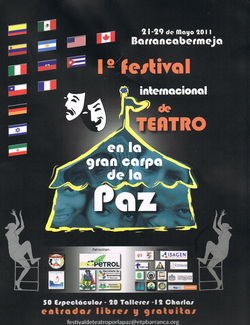 "Theatre Festival!” said the taxi driver. “Spending money on theatre when people
don’t have food to eat! What for?” That’s what I hoped to find out from May 20-30 in Barrancabermeja, Colombia where I would offer a series of writing workshops and seek to answer questions of my own: How could theatre contribute to peace in a country where the armed conflict has gone on for six decades? How did the violence come to an end in this particular city — center of the country’s oil industry, once the site of battles pitting guerrilla forces against the Colombian army, and paramilitary death squads against civilians? What did it mean to hold an International Theatre Festival for Peace when till 2010, during the eight years of the Uribe administration, anyone who talked about peace or a political solution to the country’s woes risked being called a terrorist — a label that could target you for assassination? When I visited Colombia in 2008, the human rights community in Bogotá seemed demoralized and diminished. The only people I saw protesting openly in the capital were those whose patriotism could not be questioned: family members of soldiers and police held captive by the FARC guerrillas. What I did not realize at the time was that in the most profound sense, peace is more than the cessation of war. Though dissent was silenced in many ways, people were coming together in nonviolent social movements to create and sustain a culture of peace, one that would start at society’s roots, in the community and in the home. In Barrancabermeja I would see how theatre and the arts are reweaving the torn social fabric in communities traumatized by terror, violence, and social disruption. * * * Barrancabermeja is a city of contradictions, typified perhaps by two monuments. One, the wire-sculpture of Cristo Petrolero that presides over the contaminated pool in front of Colombia’s major oil refinery. (Not even Christ can clean these waters, say the locals.) The other is the monument to Father Camilo Torres, the guerrilla priest, who fell in battle during his first combat experience alongside the fighters of the Ejército de Liberación Nacional, the ELN. Today, while violence rages unabated in the rural districts nearby, national police and soldiers are everywhere in Barrancabermeja, providing security rather than peace, but in an unlikely show of coexistence, the monument stands. Children slide on its sloping metal base, and the priest’s words are memorialized: “The constant revolutionary struggle of the people will lead to victory.” Another paradox: the Festival — the first major cultural event this city of more than 200,000 had ever seen — was born in one of its most deprived and stigmatized neighborhoods, Comuna 7, populated first by squatters, families fleeing violence in the countryside only to find themselves again under attack. The most painful and notorious incident took place during a Mother’s Day celebration in 1998. Rightwing paramilitary death squads swept in killing some young men on the spot and disappearing others while the Colombian military stood by and failed to intervene. The community still waits for justice. Twenty families still wait to recover the bodies of their children. But the community organized itself to resist violence and oppression. People once perceived as victims harnessed their own disciplined, principled, creative imagination to present alternatives to the status quo. They created institutions to strengthen community and civil society and to educate children for social responsibility by claiming, using, and expanding cultural space. In 2007, Yolanda Consejo Vargas, a dancer and theatre artist born in Mexico, and her husband, Italian-born director Guido Ripamonti, brought their itinerant theatre company to Colombia. Inspired by what they saw in Comuna 7, they decided to stay. Yolanda and Guido began offering classes in theatre and literature and dance as well as training their students to go into primary schools to share what they’d learned. A year ago, Yolanda had the idea that the Centro Cultural Horizonte Ciudadela Educativa should organize an international festival with the entire city invited to attend all events for free. The logistics were daunting, starting with how to feed and house the 400 participants who agreed to attend — including, from Los Angeles, me and my Colombian-born collaborator, Hector Aristizábal, who would perform our play, Viento Nocturno. Comuna 7, this most marginalized of neighborhoods, reached out and formed alliances and gained support from every sector: the oil company, the mayor’s office, the church, the television station, regional peace and development agencies, hotel owners, schools, and more. Not a single theatre exists in Barrancabermeja so Yolanda and Guido got a tent large enough to seat 800 people and up it went on the lawn between the city’s only library and its university. Most nights, it was standing room only. A women’s committee cooked and delivered hundreds of freshly prepared meals to the festival site every day. Yolanda’s students rehearsed for the premiere of “Preludio,” an intensely physical, imagistic, often abstract representation of what they and their families had endured and how they had chosen the path to peace and reconciliation. Artists arrived from 14 countries to present 50 performances and lead 20 different workshops. Activists and academics offered presentations and discussion groups, while community groups from all over Colombia presented their own plays and shared experiences with each other and with the international guests — notably the Mexican theatre companies coming from the borderlands of narco-wars and mass graves, where, in the words of director Medardo Treviño, “violence, jaws dripping blood, ran whipping through the streets of my town.” His troupe members begged, borrowed, and pawned their possessions to finance the trip to Colombia, intent on learning how Colombians hold onto a moral center and a vision of humanity and keep on creating in spite of the conflict raging around them. * * * The young people of Teatro Encarte created Voces del Barrio, a play that powerfully brings to life the world of sicarios, the teenage assassins who made Medellín so notorious in the 1980s and 1990s. “Yes, there’s still violence in some parts of town, including where my mother lives,” said Wilfer Giraldo, an articulate and personable group member. “But Medellín is a beautiful city and people shouldn’t be afraid to visit. The culture of the city has been transformed.” “Your play focuses on the violence,” I said. “So people won’t forget how bad it used to be. If people remember, they won’t let it happen again.” Wilfer also told me that before he joined Teatro Encarte he was resentful and anti-social. “Onstage, I like playing characters who are bitter and mean. I see what they’re like, and then I can’t allow myself to be that way.” Like the city itself, he said, “I’ve changed.” * * * “I don’t want to sound too optimistic,” said Carlos Lozano, director of the leftwing weekly, Voz, as he spoke about the possibility of a political — rather than military — solution to Colombia’s conflict. “Now we see some positive spaces opening up, a moment in Colombian life [since the start of the Santos administration] when grassroots organizations have a different relationship with power.” As he spoke, it sounded so familiar: a president who says good things while old policies continue; a corrupt and recalcitrant Congress intent on blocking real change; a government that spends six times as much on a soldier as on the education of a child. “The ruling classes of Colombia — both main parties — have refused to address agrarian reform, hunger, poverty. For all the military force, and all the money from the United States” — more than $6 billion, I’ll note — “the guerrilla movement has not been crushed in 60 years of fighting because the causes still exist.” Lozano sees government policy going off in all directions at once. Five million Colombians have been violently driven from their land and their homes. “The plan is to help people return to their property,” he said, “but at the same time, the national plan for development is all about privatization, the concentration of land in the hands of agribusiness and foreign transnational investment. The way the government sees it, small farms don’t hire anyone and plantations do. Self-sufficiency loses out to employment statistics. And if the Free Trade Agreement goes through, the situation will get worse. “What good does it do to reach a peace accord with the guerrilla if at the same time you’re deepening the wretched poverty of the country?” He urged people to take advantage of the lessening of repression. “The way to go is people in the streets. Unity among the popular and social organizations and the left. We have to get into the street with a platform. Peace won’t come from the Casa de Nariño,” the presidential palace, he concluded. * * * Small farms taken over by African palm plantations for the production of biofuels. That was the subject community members chose for their experiment with Forum Theatre, a technique first developed by the late Brazilian theatre artist and activist Augusto Boal. Hector, along with Till Bauman from Berlin, Germany and members of Bogotá’s Corporación Otra Escuela, helped participants create a play. At the end of the week, the group performed in the tent and then invited the public to intervene in the drama. Spectators in the audience became “spect-actors,” replacing cast members on the stage, replaying scenes, rehearsing for real life as they tried out different ways of responding to the situation: What could they say? What could they do? How could they offer resistance? * * * African palm is not the only reason Colombians have to leave their homes. María Fernanda Medina Gutiérrez was three years old when the Colombian Air Force, acting on behalf of Occidental Petroleum and with inaccurate information provided by the US, dropped fragmentation bombs on her village. Hermelinda Tulivila Díaz remembers what happened in 2003 when the army came to her community on the indigenous Sicuane reservation and gave people 30 minutes to get out or be killed. Since then Hermelinda’s father was killed by guerrillas. Three of María Fernanda’s brothers were killed: two by persons unknown, one — who was not charged with anything — was taken away barefoot by Colombian soldiers and executed outside of town without a trial. After eight years of displacement, her family has returned to their village but they no longer own their land. Today, both teens participate in a theatre program funded by the UN High Commissioner for Refugees. According to Paul David Pinzón who leads the group Routes of Orientation through Theatre (R.O.T.), there is an ongoing humanitarian crisis in the Arauca region. Tensions reached a boiling point as displaced communities of small farmers crowded into a zone populated by indigenous peoples, and where soldiers now outnumber civilians. In 2007 and 2008, the UN office offered training for community leaders, preparing them to demand their rights be respected and enforced. The program backfired by making community leaders easy to identify, marking them for assassination. The UN shifted gears and began the R.O.T. program for young people to ease racial and cultural tensions, strengthen the community to help youth resist forced recruitment into the guerrilla ranks, and create a culture that rejects domestic and gender-based violence. “Theatre tries to get us to trust each other more,” said Hermelinda. She speaks quietly, shyly, and I think I can hear Sicuane sentence structure and accent in her Spanish. When she talks about the theatre group, her first friendly connections ever with non-indigenous kids, and the traditional dances she performs for them, her eyes light up and the words pour out, sentences punctuated with lots of chévere! and bacán! (great, far out, fantastic!). Hermelinda ran away from home to escape a forced marriage and took refuge with a staff member at the school where she continues her studies. She gets up at four to make breakfast and do chores. After class and every Saturday and Sunday she goes to her job at a local store. When does she find time for the theatre group? At night, she says. She wouldn’t miss it. Rehearsing at night is not the problem, María Fernanda said. “The difficult part is taking the road to get to the theatre. There was a car bomb in Caño Limón the other day. The next day there was another attack on the army. I was huddled against a car when the bullets were flying. The car turned out to be full of explosives, but even so, I had to protect myself from the bullets.” But “in the theatre, I feel free,” she said. “I express myself. It’s like finding a sense of nobility after all the years of feeling unsheltered, not knowing where to go or what to do.” * * * While the country waits for peace, Father Leonel Narváez is sowing the seeds. Sociologist, Catholic priest, and founder of ES.PE.RE, Escuelas de Perdón y Reconciliación (Schools of Forgiveness and Reconciliation) his talk was one of the first events of the festival. “Forgiveness is a phenomenal religious resource,” he began, “but it must also be a political virtue.” Without it, “the moment comes when society is no longer viable.” To people still traumatized, still grieving, he offers a new way of thinking about forgiveness. “To forgive does not mean to forget. Justice must be done, and reparations. That’s the duty of the Colombian government.” But too many of us, he warned, are stuck with a tape repeating in our brains, playing over and over, bitter hatred engendering rage and then revenge. That must change. “Forgiveness can exist without reconciliation,” he said “Self-reparation, that’s for us to do for ourselves. In forgiving, I give myself a wonderful gift. I reconstitute my inner self.” A woman named Doña Emilia stood with tears in her eyes. “Forgiveness? I don’t know it. Tell me what color it is as I don’t see it anywhere.” “We honor your grief,” he said. He explained that people come to his programs for many hours as no one can be quickly or easily relieved of so much pain. “In Colombia, we have suffered. We walk down the street and we see the people who’ve killed our family members. But we need to do this. “Think of it as personal aesthetics: People who don’t forgive are ugly and wrinkled. Their hair falls out,” said the bald priest, aiming for and getting the laugh. A man stood, confused. “Father, I always thought forgiveness was me going to that person and accepting him as my brother in spite of what he did.” “Forgiveness is not about taking the offender by the hand.” “So what you’re saying, do I understand this right? It’s a matter of personal hygiene?” “It’s something we in Colombia have to work at every day,” said Father Leonel. “If we don’t, the germs that breed violence will erupt again in a perpetual cycle of bitterness and revenge. Besides the culture of peace, we need a culture of forgiveness, a gift to pass down in families from parent to child.” * * * None of this is easy. “Forgive?” some people told me. “It’s too hard.” María Fernanda admitted, “Deep inside, a person holds bitter feelings that can turn to rage.” But they came to Barrancabermeja anyway, intent on walking the road to peace. The First International Theatre Festival for Peace taught many lessons and not the least was this: When Yolanda’s dream came true, we learned that sometimes the difficult, the improbable, the quixotic can be realized. Through ten days of laughter and tears and reflection and art, we were there: we witnessed a utopian vision come vividly, vibrantly, to life. Heading off to the Frida Kahlo Theatre today to begin the workshop of God's Flea with Fernando Castro's Grupo Ta'Yer.
Fernando asked me to adapt the classic Colombian short story, En la diestra de Dios Padre by Tomás Carrasquilla Naranjo (1858-1940). What was funny to me was how even atheist Colombians I know love this story which reads to me a bit like a Sunday School lesson. (I think it must remind them of childhood.) In it, the saintly Peralta feeds and shelters the poor, much to the distress of his sister, and is rewarded by Jesus and St. Peter who visit in disguise and grant his rather strange wishes. Certainly I endorse his generosity and Catholic social justice teachings! But... So I asked Fernando if it would be OK to move the action to the US-Mexico border where Peralta helps migrants in defiance of the very devil of a sheriff. And so that the lesson wouldn't be quite so preachy, I made Peralta's greedy sister the main character and she is to be played by a cross-dressed male--not an attractive cross-dressed male. So today, let's see what happens, what works and what doesn't work. I'm looking forward to meeting the cast and hope Ruben Amavizca (who I think is pretty brilliant) will direct. Also today, should get my ticket booked for Barrancabermeja, Colombia. I'm not sure exactly what I'm going to do in my workshop there or how much time I'll have or how many participants, so I'm preparing extra exercises. One idea I have uses Chaucer's Wife of Bath as a starting point so I spent yesterday adapting the story and translating it into Spanish. See, I can make fun of Peralta's sister, but in the end, it's Womens Rights! Thank you, Maggie Grant for inviting me to sit in on yesterday's rehearsal of my play at the Luna Playhouse, Glendale. I can't wait to meet the rest of the cast and get everyone's names so I can give full credit to some terrific actors. It was such a treat to connect with Three Roses Players and meet a company interested in both sociopolitical issues and aesthetics. Performances coming up Wednesday, Sept. 22nd, Monday, Sept. 27th, Wednesday, Sept. 29th and Thursday, Sept. 30th at 8:00 PM. Tickets on sale soon: $16; $14 in advance.
|
  Author, Playwright, Troublemaker
 Archives
July 2015
Categories
All
|
 RSS Feed

![That’s what I hoped to find out from May 20-30 in Barrancabermeja, Colombia where I would offer a series of writing workshops and seek to answer questions of my own: How could theatre contribute to peace in a country where the armed conflict has gone on for six decades? How did the violence come to an end in this particular city — center of the country’s oil industry, once the site of battles pitting guerrilla forces against the Colombian army, and paramilitary death squads against civilians? What did it mean to hold an International Theatre Festival for Peace when till 2010, during the eight years of the Uribe administration, anyone who talked about peace or a political solution to the country’s woes risked being called a terrorist — a label that could target you for assassination? When I visited Colombia in 2008, the human rights community in Bogotá seemed demoralized and diminished. The only people I saw protesting openly in the capital were those whose patriotism could not be questioned: family members of soldiers and police held captive by the FARC guerrillas. What I did not realize at the time was that in the most profound sense, peace is more than the cessation of war. Though dissent was silenced in many ways, people were coming together in nonviolent social movements to create and sustain a culture of peace, one that would start at society’s roots, in the community and in the home. In Barrancabermeja I would see how theatre and the arts are reweaving the torn social fabric in communities traumatized by terror, violence, and social disruption. * * * Barrancabermeja is a city of contradictions, typified perhaps by two monuments. One, the wire-sculpture of Cristo Petrolero that presides over the contaminated pool in front of Colombia’s major oil refinery. (Not even Christ can clean these waters, say the locals.) The other is the monument to Father Camilo Torres, the guerrilla priest, who fell in battle during his first combat experience alongside the fighters of the Ejército de Liberación Nacional, the ELN. Today, while violence rages unabated in the rural districts nearby, national police and soldiers are everywhere in Barrancabermeja, providing security rather than peace, but in an unlikely show of coexistence, the monument stands. Children slide on its sloping metal base, and the priest’s words are memorialized: “The constant revolutionary struggle of the people will lead to victory.” Another paradox: the Festival — the first major cultural event this city of more than 200,000 had ever seen — was born in one of its most deprived and stigmatized neighborhoods, Comuna 7, populated first by squatters, families fleeing violence in the countryside only to find themselves again under attack. The most painful and notorious incident took place during a Mother’s Day celebration in 1998. Rightwing paramilitary death squads swept in killing some young men on the spot and disappearing others while the Colombian military stood by and failed to intervene. The community still waits for justice. Twenty families still wait to recover the bodies of their children. But the community organized itself to resist violence and oppression. People once perceived as victims harnessed their own disciplined, principled, creative imagination to present alternatives to the status quo. They created institutions to strengthen community and civil society and to educate children for social responsibility by claiming, using, and expanding cultural space. In 2007, Yolanda Consejo Vargas, a dancer and theatre artist born in Mexico, and her husband, Italian-born director Guido Ripamonti, brought their itinerant theatre company to Colombia. Inspired by what they saw in Comuna 7, they decided to stay. Yolanda and Guido began offering classes in theatre and literature and dance as well as training their students to go into primary schools to share what they’d learned. A year ago, Yolanda had the idea that the Centro Cultural Horizonte Ciudadela Educativa should organize an international festival with the entire city invited to attend all events for free. The logistics were daunting, starting with how to feed and house the 400 participants who agreed to attend — including, from Los Angeles, me and my Colombian-born collaborator, Hector Aristizábal, who would perform our play, Viento Nocturno. Comuna 7, this most marginalized of neighborhoods, reached out and formed alliances and gained support from every sector: the oil company, the mayor’s office, the church, the television station, regional peace and development agencies, hotel owners, schools, and more. Not a single theatre exists in Barrancabermeja so Yolanda and Guido got a tent large enough to seat 800 people and up it went on the lawn between the city’s only library and its university. Most nights, it was standing room only. A women’s committee cooked and delivered hundreds of freshly prepared meals to the festival site every day. Yolanda’s students rehearsed for the premiere of “Preludio,” an intensely physical, imagistic, often abstract representation of what they and their families had endured and how they had chosen the path to peace and reconciliation. Artists arrived from 14 countries to present 50 performances and lead 20 different workshops. Activists and academics offered presentations and discussion groups, while community groups from all over Colombia presented their own plays and shared experiences with each other and with the international guests — notably the Mexican theatre companies coming from the borderlands of narco-wars and mass graves, where, in the words of director Medardo Treviño, “violence, jaws dripping blood, ran whipping through the streets of my town.” His troupe members begged, borrowed, and pawned their possessions to finance the trip to Colombia, intent on learning how Colombians hold onto a moral center and a vision of humanity and keep on creating in spite of the conflict raging around them. * * * The young people of Teatro Encarte created Voces del Barrio, a play that powerfully brings to life the world of sicarios, the teenage assassins who made Medellín so notorious in the 1980s and 1990s. “Yes, there’s still violence in some parts of town, including where my mother lives,” said Wilfer Giraldo, an articulate and personable group member. “But Medellín is a beautiful city and people shouldn’t be afraid to visit. The culture of the city has been transformed.” “Your play focuses on the violence,” I said. “So people won’t forget how bad it used to be. If people remember, they won’t let it happen again.” Wilfer also told me that before he joined Teatro Encarte he was resentful and anti-social. “Onstage, I like playing characters who are bitter and mean. I see what they’re like, and then I can’t allow myself to be that way.” Like the city itself, he said, “I’ve changed.” * * * “I don’t want to sound too optimistic,” said Carlos Lozano, director of the leftwing weekly, Voz, as he spoke about the possibility of a political — rather than military — solution to Colombia’s conflict. “Now we see some positive spaces opening up, a moment in Colombian life [since the start of the Santos administration] when grassroots organizations have a different relationship with power.” As he spoke, it sounded so familiar: a president who says good things while old policies continue; a corrupt and recalcitrant Congress intent on blocking real change; a government that spends six times as much on a soldier as on the education of a child. “The ruling classes of Colombia — both main parties — have refused to address agrarian reform, hunger, poverty. For all the military force, and all the money from the United States” — more than $6 billion, I’ll note — “the guerrilla movement has not been crushed in 60 years of fighting because the causes still exist.” Lozano sees government policy going off in all directions at once. Five million Colombians have been violently driven from their land and their homes. “The plan is to help people return to their property,” he said, “but at the same time, the national plan for development is all about privatization, the concentration of land in the hands of agribusiness and foreign transnational investment. The way the government sees it, small farms don’t hire anyone and plantations do. Self-sufficiency loses out to employment statistics. And if the Free Trade Agreement goes through, the situation will get worse. “What good does it do to reach a peace accord with the guerrilla if at the same time you’re deepening the wretched poverty of the country?” He urged people to take advantage of the lessening of repression. “The way to go is people in the streets. Unity among the popular and social organizations and the left. We have to get into the street with a platform. Peace won’t come from the Casa de Nariño,” the presidential palace, he concluded. * * * Small farms taken over by African palm plantations for the production of biofuels. That was the subject community members chose for their experiment with Forum Theatre, a technique first developed by the late Brazilian theatre artist and activist Augusto Boal. Hector, along with Till Bauman from Berlin, Germany and members of Bogotá’s Corporación Otra Escuela, helped participants create a play. At the end of the week, the group performed in the tent and then invited the public to intervene in the drama. Spectators in the audience became “spect-actors,” replacing cast members on the stage, replaying scenes, rehearsing for real life as they tried out different ways of responding to the situation: What could they say? What could they do? How could they offer resistance? * * * African palm is not the only reason Colombians have to leave their homes. María Fernanda Medina Gutiérrez was three years old when the Colombian Air Force, acting on behalf of Occidental Petroleum and with inaccurate information provided by the US, dropped fragmentation bombs on her village. Hermelinda Tulivila Díaz remembers what happened in 2003 when the army came to her community on the indigenous Sicuane reservation and gave people 30 minutes to get out or be killed. Since then Hermelinda’s father was killed by guerrillas. Three of María Fernanda’s brothers were killed: two by persons unknown, one — who was not charged with anything — was taken away barefoot by Colombian soldiers and executed outside of town without a trial. After eight years of displacement, her family has returned to their village but they no longer own their land. Today, both teens participate in a theatre program funded by the UN High Commissioner for Refugees. According to Paul David Pinzón who leads the group Routes of Orientation through Theatre (R.O.T.), there is an ongoing humanitarian crisis in the Arauca region. Tensions reached a boiling point as displaced communities of small farmers crowded into a zone populated by indigenous peoples, and where soldiers now outnumber civilians. In 2007 and 2008, the UN office offered training for community leaders, preparing them to demand their rights be respected and enforced. The program backfired by making community leaders easy to identify, marking them for assassination. The UN shifted gears and began the R.O.T. program for young people to ease racial and cultural tensions, strengthen the community to help youth resist forced recruitment into the guerrilla ranks, and create a culture that rejects domestic and gender-based violence.](http://www.newclearvision.com/wp-content/uploads/2011/06/Festival-poster.jpg)