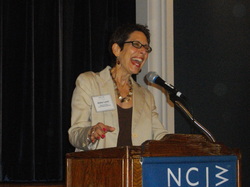
Abbe Land
In today's LA Progressive:
Abbe Land, West Hollywood Mayor Pro Tem, doesn't want activists to think of "lobbying" as a dirty word. "In the purest form, it's about educating and helping elected officials understand the issue," she told more than 100 community members attending the July 25th workshop, "Your Voice: Learning to Lobby for Social Change," organized by the Advocacy Committee of the National Council of Jewish Women/Los Angeles. "Paid lobbyists can keep knocking on your door till you let them in, keep telling you their side, their side, their side--till it's possible forget about the other side." Progressive organizations lobby, too, "to move our agenda forward," she said in her keynote address, but don't have the resources to keep up that kind of constant pressure without the help of the individual activist. The role of citizen lobbyist is crucial.
In the breakout sessions that followed, community members got tips about individual activism while much of the discussion focused
on the role of organized nonprofits as well as informal ad hoc advocacy groups.
(While 501(c)(3) nonprofits can lose their tax-exempt status if lobbying takes more than 5% of their time and resources, they are not
banned entirely from approaching officials on behalf of specific legislation. Good information on how to navigate rules and restrictions and maximize lobbying to the full extent of the law is available at the website of the organization Alliance for Justice.)
Abbe Land, West Hollywood Mayor Pro Tem, doesn't want activists to think of "lobbying" as a dirty word. "In the purest form, it's about educating and helping elected officials understand the issue," she told more than 100 community members attending the July 25th workshop, "Your Voice: Learning to Lobby for Social Change," organized by the Advocacy Committee of the National Council of Jewish Women/Los Angeles. "Paid lobbyists can keep knocking on your door till you let them in, keep telling you their side, their side, their side--till it's possible forget about the other side." Progressive organizations lobby, too, "to move our agenda forward," she said in her keynote address, but don't have the resources to keep up that kind of constant pressure without the help of the individual activist. The role of citizen lobbyist is crucial.
In the breakout sessions that followed, community members got tips about individual activism while much of the discussion focused
on the role of organized nonprofits as well as informal ad hoc advocacy groups.
(While 501(c)(3) nonprofits can lose their tax-exempt status if lobbying takes more than 5% of their time and resources, they are not
banned entirely from approaching officials on behalf of specific legislation. Good information on how to navigate rules and restrictions and maximize lobbying to the full extent of the law is available at the website of the organization Alliance for Justice.)
Legislate? Or Educate?
There's no limit on 501(c)(3) organizations (or anyone else) when it comes to campaigns to educate officials about issues.
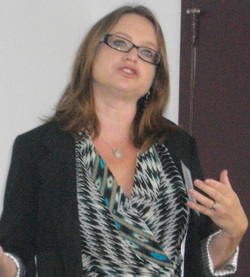
Emily Austin, who facilitated the workshop on "Policy Process 101: Transforming Ideas into Policy," explained that education must sometimes precede any attempt to make policy given the many obstacles to
getting a bill into law. Even if you can get legislation introduced, it's
likely to die in committee unless the ground has been fully
prepared.
To illustrate how this might work in real life, Austin
shared her experience addressing teen dating violence in her role as Director of
Policy & Evaluation for Peace Over Violence, a nonprofit dedicated to intervention and prevention of domestic violence and sexual assault. Through its work with survivors, POV was aware that many teens were victimized but when staff went to the broader community, they found parents insisting their kids didn't even date so couldn't possibly be affected.
POV collected statistics and reports to show the prevalence of the violence and began to collect powerful personal stories as well.
"Think about who your allies might be," she said. "Unlikely allies, too." Progressives sometimes overlook the support a cause
might get from groups--in this case, law enforcement and prosecutors--that aren't always in agreement with our values.
You also need to identify the opposition and what their arguments might be. An Orange County politician, for example, was opposed to any discussion of dating violence because dating implied sexual activity. In today's economy, you can expect arguments about funding, so think about possible resources and be ready to make the argument--with specific figures--that
spending money now will prevent higher costs later.
Determine your venue, Austin said. Do you think the issue is best addressed on a federal, state, local, or organizational level?
Once you know your venue, find a champion there. Whether a bill needs to be shepherded into law or a regulation or policy needs to change in a bureaucracy, someone has to work toward this goal with almost single-minded focus and push hard for it in a knowledgeable and articulate way.
POV connected early on with Steve Zimmer, a Los Angeles teacher and counselor for 17 years, who knew firsthand that students
were suffering abuse. When he was later elected to the school board, he became an ideal champion--committed, able to speak at a press conference in an entirely credible way. He didn't need to have talking point provided to him and was able to answer any questions with ease. (As Abbe Land pointed out, a paid lobbyist has to be prepared because they get fired if they don't know the issue very well. We have to be sure we are every bit as knowledgeable when we speak to people in power.) In October 2011, Zimmer got the school board to pass a unanimous resolution in favor of a prevention program for the city's public schools. Though no funds have been identified yet to implement such a program or the curriculum prepared by POV, the problem--after years of educating the community--is at last officially recognized. As Austin said, "It's on the map." Even this limited progress to the goal took years while POV did the research, developed and nurtured relationships, and prepared the ground with public awareness.
For now, the organization continues to educate peer leaders who can talk to other teens. And while you're figuring out how to
influence others, Austin said, look at your own organization. Is it living up to its stated goals? For example, when people think of teen dating violence, the common assumption is this refers to girls who are victims of boys. Austin said POV looked to be sure its own board and policies were friendly to LGBT teens and youth who were questioning their sexuality and/or gender.
Whatever your cause, remember you need to raise community awareness and support before trying to promote a bill. Sometimes,
Austin warned, the community may get passionately behind a cause after a particularly terrible event. These laws sometimes go through quickly--too quickly. "Legislation created after one specific set of facts--such as laws that tend to be named after a survivor or victim" are often poorly drafted "without thinking of unintended consequences." Think through any proposed bills or recommendations with care.
There's no limit on 501(c)(3) organizations (or anyone else) when it comes to campaigns to educate officials about issues.
Emily Austin, who facilitated the workshop on "Policy Process 101: Transforming Ideas into Policy," explained that education must sometimes precede any attempt to make policy given the many obstacles to
getting a bill into law. Even if you can get legislation introduced, it's
likely to die in committee unless the ground has been fully
prepared.
To illustrate how this might work in real life, Austin
shared her experience addressing teen dating violence in her role as Director of
Policy & Evaluation for Peace Over Violence, a nonprofit dedicated to intervention and prevention of domestic violence and sexual assault. Through its work with survivors, POV was aware that many teens were victimized but when staff went to the broader community, they found parents insisting their kids didn't even date so couldn't possibly be affected.
POV collected statistics and reports to show the prevalence of the violence and began to collect powerful personal stories as well.
"Think about who your allies might be," she said. "Unlikely allies, too." Progressives sometimes overlook the support a cause
might get from groups--in this case, law enforcement and prosecutors--that aren't always in agreement with our values.
You also need to identify the opposition and what their arguments might be. An Orange County politician, for example, was opposed to any discussion of dating violence because dating implied sexual activity. In today's economy, you can expect arguments about funding, so think about possible resources and be ready to make the argument--with specific figures--that
spending money now will prevent higher costs later.
Determine your venue, Austin said. Do you think the issue is best addressed on a federal, state, local, or organizational level?
Once you know your venue, find a champion there. Whether a bill needs to be shepherded into law or a regulation or policy needs to change in a bureaucracy, someone has to work toward this goal with almost single-minded focus and push hard for it in a knowledgeable and articulate way.
POV connected early on with Steve Zimmer, a Los Angeles teacher and counselor for 17 years, who knew firsthand that students
were suffering abuse. When he was later elected to the school board, he became an ideal champion--committed, able to speak at a press conference in an entirely credible way. He didn't need to have talking point provided to him and was able to answer any questions with ease. (As Abbe Land pointed out, a paid lobbyist has to be prepared because they get fired if they don't know the issue very well. We have to be sure we are every bit as knowledgeable when we speak to people in power.) In October 2011, Zimmer got the school board to pass a unanimous resolution in favor of a prevention program for the city's public schools. Though no funds have been identified yet to implement such a program or the curriculum prepared by POV, the problem--after years of educating the community--is at last officially recognized. As Austin said, "It's on the map." Even this limited progress to the goal took years while POV did the research, developed and nurtured relationships, and prepared the ground with public awareness.
For now, the organization continues to educate peer leaders who can talk to other teens. And while you're figuring out how to
influence others, Austin said, look at your own organization. Is it living up to its stated goals? For example, when people think of teen dating violence, the common assumption is this refers to girls who are victims of boys. Austin said POV looked to be sure its own board and policies were friendly to LGBT teens and youth who were questioning their sexuality and/or gender.
Whatever your cause, remember you need to raise community awareness and support before trying to promote a bill. Sometimes,
Austin warned, the community may get passionately behind a cause after a particularly terrible event. These laws sometimes go through quickly--too quickly. "Legislation created after one specific set of facts--such as laws that tend to be named after a survivor or victim" are often poorly drafted "without thinking of unintended consequences." Think through any proposed bills or recommendations with care.
Everyone Has a Role
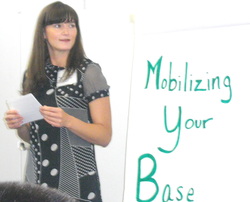
Serena Josel, Director of Public Affairs at Planned Parenthood Los Angeles, spoke on "Mobilizing Your Base: Grassroots and Grasstops Lobbying"
For legislative advocacy, she said, you need three ongoing components that work together: a policy analysis team to study a bill and consider what real-life impact it would have; a media team to communicate these impacts to the public; a lobbying team of paid lobbyists if possible, plus the grassroots and the grasstops, the latter being members or allies of your group who are prominent in the community or have special relationships or access to decision makers because they are big donors or as colleagues or former staffers or through, for example, family, friendship, business.
"Last spring when Congress tried to defund Planned Parenthood," she said, "what did we do?" First, the policy team warned the organization to take the threat seriously. Though the same amendment had been offered in Congress every year for six years, it never before had a chance of passing. This time, the policy team put out the alert that "it had legs." The media team got to work with radio and television interviews and social media to make the buzz louder and get people engaged.
As for the grassroots lobbyists, how much could they accomplish here in LA where Planned Parenthood enjoys strong longterm
support from our elected representatives? First, whatever your cause, if you've got a compelling personal story, an official who's already on your side can use it in working to convince others. Then, Los Angeles grassroots activists turned to technology. They phoned sympathetic voters in targeted states, told them what was happening in DC and said "Your senator will be one of the deciding votes. Will you let me patch you into their office right now?" In this way, people power in Los Angeles generated calls to senators all around the country. "We won on the federal level," Josel said, though Planned Parenthood is still under attack in eight states.
Grassroots volunteers have also fanned out with cell phones on college campuses and at farmers markets, talking to people and
inviting supporters to make calls on-the-spot to elected officials.
As for the grasstops, Josel passed around copies of a sample chart set up to list all the decision makers relevant to an issue. After you poll the organization's board and active members, you fill in the blanks on the chart: who has a personal connection to each decision maker; who is a professional contact; who knows someone who is an indirect contact and in those cases, fill in that person's name and the nature of the relationship. You can then identify who is best suited to make the approach.
Don't ask your grasstops to call everyone they know, Josel advised. Choose targets with care. Track what happens. Some grasstops turn out to be have more clout than they expected; some less.
Before any contact is made, the grasstops spokeperson should be carefully prepared. Their relationship means they are likely to have a real back-and-forth conversation with the decision maker so they'll need to know their stuff. The organization can follow up later with additional information if needed and, of course, with thank you notes.
Decision makers who support you need to be thanked whenever they do the right thing with their vote, Josel said. Just because a person's belief system matches up with yours, doesn't mean they'll always want to go out on a limb for you, especially in an election year. Let them know that constituents have their back by sending a note or a even a photo of a large group of people holding up a big thank you sign.
Keep your grassroots people engaged with updates and reports of progress.
Tips for Individuals
Citizen lobbying is most effective when the decision maker can see you face-to-face (in their district or Capitol office or at a town hall meeting) or at least hear your voice on the phone. Meeting with an official's staff members is just as valuable.
Personal letters get more attention than petitions or mass emails. Snail mail shows a higher level of commitment than email. But keep in mind: Physical letters sent to local district offices will rarely be subject to delay but in DC, mail goes through security screening and can take several weeks to reach the recipient. For an urgent matter or when a vote is imminent, phone calls and personally composed emails are necessary.
Use personal language, Josel said, not political jargon or bumper sticker language, e.g., talk about pregnancy and families, not
the opposing camps of pro-choice and pro-life.
On-line petitions may have some effect if the numbers are huge and come from appropriate zip codes.
Think about visual impact. If you're part of a pre-printed postcard campaign, save the cards and deliver them all at once. A thousand cards dumped in a legislator's office can't be ignored. The same number trickling in over the course of a year or two can be overlooked.
If your letter to the editor is published, send copies to relevant decision makers, or, a participant suggested, bcc (send blind
copies) to the people you want to influence. That way, they'll know your opinion and that you cared enough to write even if the letter isn't published.
Facebook and Twitter campaigns tend to work best with corporations concerned about their image and their brand and are less
effective when targeting elected officials. It's worth tweeting a representative who's known to use Twitter a lot. If you catch him or her during a particularly boring committee meeting, you may have the chance for an extended exchange.
A Last Word
Matt Leighty, who has worked as a lobbyist and teaches a graduate-level course on "Lobbying and Policy Change" at Pepperdine
University offered a workshop on "The Art of Persuasion: Winning Them Over," focused on preparing and delivering oral arguments. As participants could only attend two of the three breakout sessions, I missed his presentation. Which leads to my own tip to fellow activists: Don't beat yourself up if you can't do everything.
But here's something you can do. The meeting ended with:
Action Alerts
Contact Congress to support:
1. The reauthorization of the Violence against Women Act (VAWA) as approved by the Senate (S. 1925) rather than the House version (H.R. 4970) which was designed to undermine or deny protection to immigrant women (including mail-order brides), Native women, students on college campuses, and LGBTQ victims.
2. The Fair Minimum Wage Act which would raise the minimum wage in three gradual steps from $7.25 to $9.80/hour by 2014. Get
your representative on board as a co-sponsor.
If you need help finding your members of Congress and their contact info, call the Capitol switchboard at (202)224-3121 or go
online:
http://www.house.gov/representatives/find/ and
http://www.senate.gov/general/contact_information/senators_cfm.cfm/
For California actions, contact your state senator to support these Assembly bills being considered by the Senate:
1. AB 2348 which would allow RNs to dispense birth control to women who have no risk factors. Today thousands of women who
want contraception are turned away at health centers as there aren't enough doctors to see them. (If you make this call, please let Planned Parenthood know how it went by emailing [email protected]/)
2. AB 593 and AB 1593 which would aid incarcerated battered women who were unable to present a domestic violence defense at the time of a petition for habeas corpus and would give them a chance to present this evidence effectively during the parole process.
To find a California state senator:
http://www.leginfo.ca.gov/yourleg.html
Serena Josel, Director of Public Affairs at Planned Parenthood Los Angeles, spoke on "Mobilizing Your Base: Grassroots and Grasstops Lobbying"
For legislative advocacy, she said, you need three ongoing components that work together: a policy analysis team to study a bill and consider what real-life impact it would have; a media team to communicate these impacts to the public; a lobbying team of paid lobbyists if possible, plus the grassroots and the grasstops, the latter being members or allies of your group who are prominent in the community or have special relationships or access to decision makers because they are big donors or as colleagues or former staffers or through, for example, family, friendship, business.
"Last spring when Congress tried to defund Planned Parenthood," she said, "what did we do?" First, the policy team warned the organization to take the threat seriously. Though the same amendment had been offered in Congress every year for six years, it never before had a chance of passing. This time, the policy team put out the alert that "it had legs." The media team got to work with radio and television interviews and social media to make the buzz louder and get people engaged.
As for the grassroots lobbyists, how much could they accomplish here in LA where Planned Parenthood enjoys strong longterm
support from our elected representatives? First, whatever your cause, if you've got a compelling personal story, an official who's already on your side can use it in working to convince others. Then, Los Angeles grassroots activists turned to technology. They phoned sympathetic voters in targeted states, told them what was happening in DC and said "Your senator will be one of the deciding votes. Will you let me patch you into their office right now?" In this way, people power in Los Angeles generated calls to senators all around the country. "We won on the federal level," Josel said, though Planned Parenthood is still under attack in eight states.
Grassroots volunteers have also fanned out with cell phones on college campuses and at farmers markets, talking to people and
inviting supporters to make calls on-the-spot to elected officials.
As for the grasstops, Josel passed around copies of a sample chart set up to list all the decision makers relevant to an issue. After you poll the organization's board and active members, you fill in the blanks on the chart: who has a personal connection to each decision maker; who is a professional contact; who knows someone who is an indirect contact and in those cases, fill in that person's name and the nature of the relationship. You can then identify who is best suited to make the approach.
Don't ask your grasstops to call everyone they know, Josel advised. Choose targets with care. Track what happens. Some grasstops turn out to be have more clout than they expected; some less.
Before any contact is made, the grasstops spokeperson should be carefully prepared. Their relationship means they are likely to have a real back-and-forth conversation with the decision maker so they'll need to know their stuff. The organization can follow up later with additional information if needed and, of course, with thank you notes.
Decision makers who support you need to be thanked whenever they do the right thing with their vote, Josel said. Just because a person's belief system matches up with yours, doesn't mean they'll always want to go out on a limb for you, especially in an election year. Let them know that constituents have their back by sending a note or a even a photo of a large group of people holding up a big thank you sign.
Keep your grassroots people engaged with updates and reports of progress.
Tips for Individuals
Citizen lobbying is most effective when the decision maker can see you face-to-face (in their district or Capitol office or at a town hall meeting) or at least hear your voice on the phone. Meeting with an official's staff members is just as valuable.
Personal letters get more attention than petitions or mass emails. Snail mail shows a higher level of commitment than email. But keep in mind: Physical letters sent to local district offices will rarely be subject to delay but in DC, mail goes through security screening and can take several weeks to reach the recipient. For an urgent matter or when a vote is imminent, phone calls and personally composed emails are necessary.
Use personal language, Josel said, not political jargon or bumper sticker language, e.g., talk about pregnancy and families, not
the opposing camps of pro-choice and pro-life.
On-line petitions may have some effect if the numbers are huge and come from appropriate zip codes.
Think about visual impact. If you're part of a pre-printed postcard campaign, save the cards and deliver them all at once. A thousand cards dumped in a legislator's office can't be ignored. The same number trickling in over the course of a year or two can be overlooked.
If your letter to the editor is published, send copies to relevant decision makers, or, a participant suggested, bcc (send blind
copies) to the people you want to influence. That way, they'll know your opinion and that you cared enough to write even if the letter isn't published.
Facebook and Twitter campaigns tend to work best with corporations concerned about their image and their brand and are less
effective when targeting elected officials. It's worth tweeting a representative who's known to use Twitter a lot. If you catch him or her during a particularly boring committee meeting, you may have the chance for an extended exchange.
A Last Word
Matt Leighty, who has worked as a lobbyist and teaches a graduate-level course on "Lobbying and Policy Change" at Pepperdine
University offered a workshop on "The Art of Persuasion: Winning Them Over," focused on preparing and delivering oral arguments. As participants could only attend two of the three breakout sessions, I missed his presentation. Which leads to my own tip to fellow activists: Don't beat yourself up if you can't do everything.
But here's something you can do. The meeting ended with:
Action Alerts
Contact Congress to support:
1. The reauthorization of the Violence against Women Act (VAWA) as approved by the Senate (S. 1925) rather than the House version (H.R. 4970) which was designed to undermine or deny protection to immigrant women (including mail-order brides), Native women, students on college campuses, and LGBTQ victims.
2. The Fair Minimum Wage Act which would raise the minimum wage in three gradual steps from $7.25 to $9.80/hour by 2014. Get
your representative on board as a co-sponsor.
If you need help finding your members of Congress and their contact info, call the Capitol switchboard at (202)224-3121 or go
online:
http://www.house.gov/representatives/find/ and
http://www.senate.gov/general/contact_information/senators_cfm.cfm/
For California actions, contact your state senator to support these Assembly bills being considered by the Senate:
1. AB 2348 which would allow RNs to dispense birth control to women who have no risk factors. Today thousands of women who
want contraception are turned away at health centers as there aren't enough doctors to see them. (If you make this call, please let Planned Parenthood know how it went by emailing [email protected]/)
2. AB 593 and AB 1593 which would aid incarcerated battered women who were unable to present a domestic violence defense at the time of a petition for habeas corpus and would give them a chance to present this evidence effectively during the parole process.
To find a California state senator:
http://www.leginfo.ca.gov/yourleg.html



 RSS Feed
